Ice breakers that work with 60 people as well as 6
With more than a dozen people, a go-around takes half an hour, and everyone after the first few speakers just echoes them. This post is about what an ice breaker is for, why the usual format fails at scale, and a way to run one where all sixty people answer in the same ninety seconds.
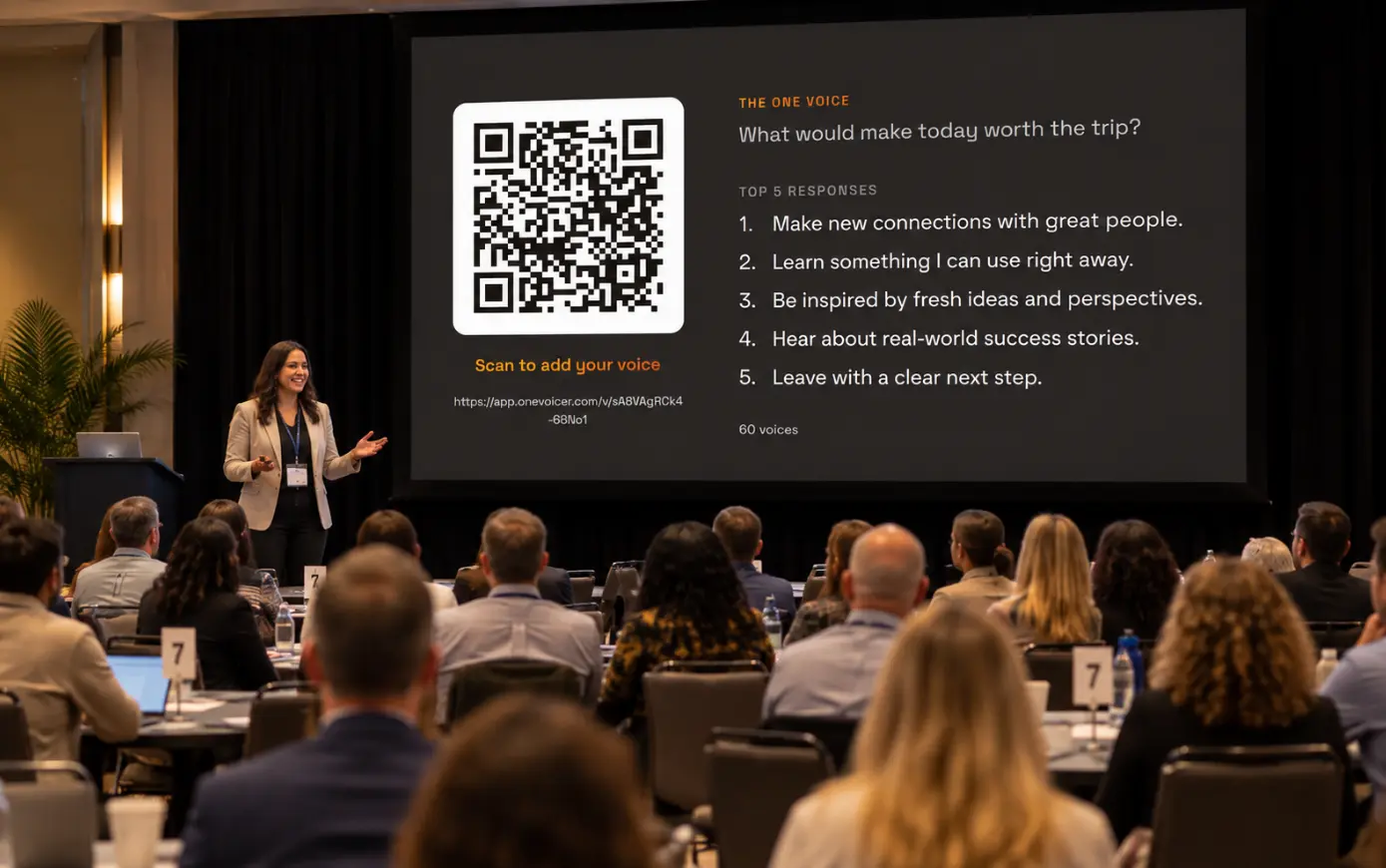
The agenda for Thursday’s offsite came back from the client with one line added near the top: “9:05, quick ice breaker (10 min).” Sixty people from four regional offices, most of whom have only ever met on a call.
You know the arithmetic on that line pretty much before you finish reading it. Sixty people at thirty seconds each is thirty minutes, and nobody keeps to thirty seconds. So the usual move is to shrink it. Name, office, one word. Or skip the go-around entirely and pair people off for two minutes, which works but leaves you with nothing you can use at 9:20.
There is a better reason to rethink the format than the clock. In 1995, Camacho and Paulus put people who were anxious about group interaction into small brainstorming groups with people who were not. The relaxed members did not lift the anxious ones. They dropped to meet them.
A go-around does the same thing at scale, in public, one person at a time, and it does it in the first ten minutes of the day.
# The go-around breaks somewhere past a dozen people
With eight people around a table, a go-around is fine. Everyone gets heard, it takes five minutes, and the facilitator learns something about each person. With sixty it is a different activity.
- Person 40
- Has been waiting twenty minutes and is rehearsing a line instead of listening.
- Persons 1 to 39
- Have already gone, and are on their phones.
- The one-word version
- Saves the clock and loses the point. Sixty words nobody wrote down.
A go-around is production blocking with a seating chart.
# Whoever speaks first sets the tone, and the nervous speak quietest
This is a version of a finding that has been sitting in the brainstorming literature for a good while now. Diehl and Stroebe showed in 1987 that most of the productivity loss in spoken groups comes from production blocking: only one person can talk at a time, and while they wait, everyone else’s thought decays.
The Camacho and Paulus result adds a direction to it. In their mixed groups of two low-anxious and two high-anxious people, the low-anxious members lowered their output toward the anxious ones. The group settled at the level of its most uncomfortable member.
In a go-around, the first three or four people set the register for length, candor and humor, and everyone after them calibrates to that. If the first person says “fine, busy, glad to be here,” the fortieth person will too, whatever they actually walked in carrying. The facilitator hears sixty variations on the first answer and learns almost nothing about the room.
In mixed groups, the low-anxious members lowered their performance in the direction of the high-anxious ones.
Camacho and Paulus, Journal of Personality and Social Psychology, 1995
# An ice breaker is a safety check, not a warm-up game
It helps to be clear about what the ten minutes are for. Amy Edmondson defined team psychological safety in 1999 as a shared belief that the team is safe for interpersonal risk taking, and showed in a study of 51 work teams that it predicts learning behavior, which in turn predicts performance.
A workshop is a temporary team, and the first interpersonal risk anyone takes in it is saying something true in front of strangers. Chlup and Collins, writing about adult learners in 2010, put the ice breaker’s job in similar terms: used thoughtfully, it builds motivation, encourages interaction and creates a sense of safety, and it is not a one-time event for the first morning.
So the job has three parts.
- Everyone takes one small risk
- Says something true, not a fun fact. A fun fact is not really a true thing so much as a thing you are allowed to say.
- Early
- In the first ten minutes, before the room has decided who talks and who does not.
- And it goes well
- The thing they said gets heard, and nothing bad happens. That is the whole safety check.
# Impromptu Networking solved this for rooms that can stand up
Liberating Structures has a direct answer to the long go-around, and it is a good one. Impromptu Networking runs three rounds of four or five minutes each, in pairs, with everyone standing and moving between rounds. The invitation is about a real challenge and the person’s role in it, and the stated purpose includes involving everyone immediately and avoiding lengthy introductions. Twenty minutes in, every person has said something honest to three other people.
What it cannot do is show the room to itself. Sixty conversations happened and the facilitator heard none of them. It also needs a room where sixty people can stand and mill, which rules out the hotel ballroom with fixed rounds, the lecture theatre and anything hybrid.
| Go-around | Impromptu Networking | Written opener | |
|---|---|---|---|
| Time with 60 people | 30 minutes or more | 20 to 25 minutes | 10 minutes |
| Everyone says something true | Eventually, in public | Yes, to three people | Yes, at once |
| The room hears itself | Sixty times, one at a time | No | Read back in two minutes |
| Seated, fixed rows, hybrid | Yes | No | Yes |
| Anything to use at 9:20 | Memory | Nothing | Every answer, saved |
# The everyone-first rule: every person says one true thing before anyone says a second
Here is the principle we have settled on. An ice breaker for a big room should get one true thing from every person before anyone in the room has said a second thing. Call it the everyone-first rule.
It rules out the go-around, because by the time person twelve speaks, person one has been talking for a while in everyone’s head. It rules out the pure pairs exercise too, because the room never hears what it said.
The way to satisfy the rule with sixty seated people is to have them write, all at once, and then read the result back to the whole room.
- Writing is simultaneous
- Nobody waits, nobody blocks. Sixty answers in ninety seconds.
- Writing is a little private
- The anxious person answers at their own register, not the first speaker’s.
- Writing can be read back
- Aloud, in the next two minutes. This is the part that makes it an ice breaker and not a survey.
When the facilitator reads six of the sixty aloud, six people have been heard by the whole room without standing up. When the facilitator reads one paragraph drawn from all sixty, the room has met itself.
# Four ice breakers that fit the rule
The prompt matters less than the mechanic, but some prompts fit it better than others. Each of these four is a single open question, answerable in a sentence, that a person can answer truthfully without having to be brave about it.
- One line for how you walked in
- The classic check-in. Answers come back as “tired but curious” and “worried about the 2pm slot.” Read a handful aloud, then read the room’s portrait of its own mood. Two minutes, and the tone is set by all sixty instead of the first three.
- What would make today worth the trip?
- Our preferred opener for a paid engagement, because it doubles as an expectations check. If forty answers mention the same unresolved decision, you know it at 9:12 and not at the lunch break.
- Something you are good at that is not on your job title
- Best for rooms of strangers. The list makes people findable: “there are three woodworkers in here, find each other at the break” is a better networking prompt than any badge color.
- One thing your table has in common that you did not expect
- For rooms already at tables. Give them three minutes to talk, then one phone per table sends the answer. Works as the “All” step of a short 1-2-4-All.
# How a facilitator runs it with OneVoicer, beat by beat
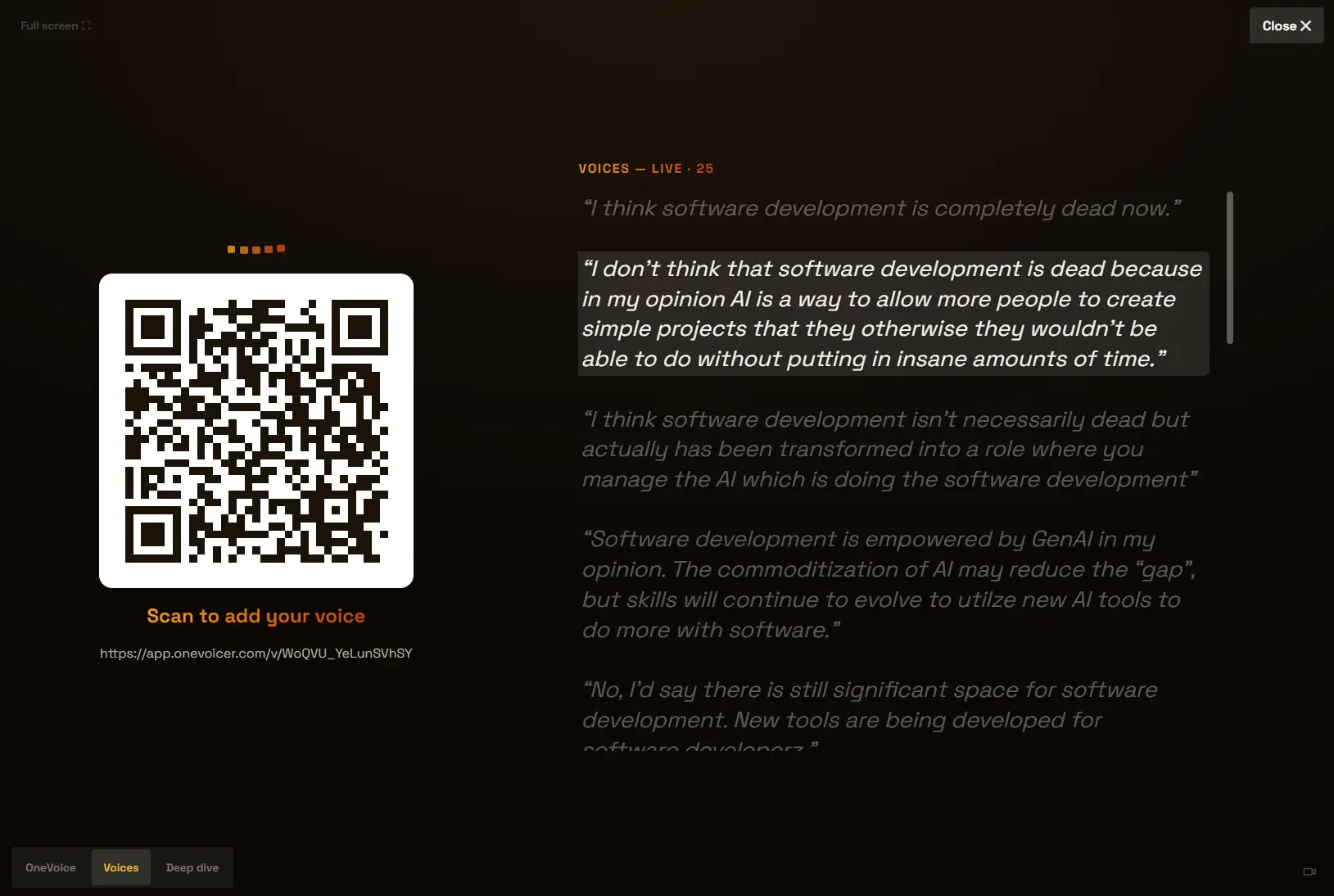
This is the job OneVoicer was built for, so here is the run of show for a sixty-person opener.
- The day before
- Build the question with the optional name field left on. Check the wording once; it can be edited live, but answers already in stay as they were.
- Before anyone arrives
- Put the presentation view on the screen: the question and a large QR code. Early arrivals scan and answer while the room is still finding seats. By 9:05 you may have twenty answers and have given no instructions.
- 9:05, say it once
- Read the prompt aloud and give a firm ninety seconds. Keep the screen in Voices mode, which lists each answer as it lands, newest first. Early answers give permission to the slower starters.
- While they type
- A respondent sees the blended answer only after adding their own, so nobody writes to match the crowd. Each answer is capped at 280 characters, so the list stays readable from the back.
- 9:07, read six aloud
- Pick for range. Use names where they were offered.
- 9:09, read the room
- Switch the screen to OneVoice, the single paragraph blended from every answer, and read it as “here is who is in the room this morning.” Prompt to read-back fits inside the slot on the agenda.
# Use the answers, or you ran a warm-up game after all
The thing that separates a professional’s ice breaker from a filler is what happens at 9:16. Sixty written answers are sitting there.
- Adjust the agenda
- If the opener was “what would make today worth the trip,” the blend is your agenda check, and you can say so: “four of you said the pricing decision, so we are moving that up.”
- Pair people
- If it was the hidden-talent question, the list is your pairing tool for the afternoon.
- Keep the QR code up
- If the opener is the first question in a group, the same code stays on the screen for the real questions that follow, so the room scans once.
- Start the report
- Every answer stays saved, and a deep dive turns the set into a six-card report. On an opener that reads as what the room came in expecting. More on that below.
# What the deep dive says about sixty people at nine in the morning
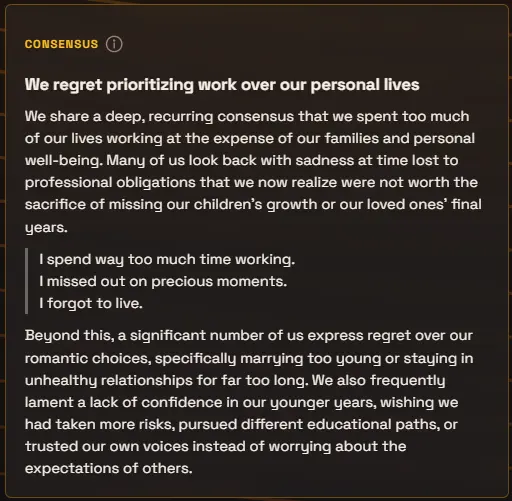
The deep dive is OneVoicer’s report on a set of answers. It reads the same sixty voices through six fixed lenses, in order from agreement to tension, and each card cites the answers it drew on. Run on the opener, the cards come out like this.
- Consensus
- What most of the room came in expecting, and how solid that agreement is.
- Priorities
- The same expectations ranked by how many raised them and how strongly.
- Minority Voice
- The two people who came for something else, and whether it is worth a slot.
- Dissent
- The best case against what the majority wants from the day, in the dissenters’ own words.
- Positive Deviance
- Anyone who already has what the rest are hoping for, and what they did differently.
- Tensions
- The room that wants a clear next step and also wants time to explore. Both are true, and the agenda has to hold both.
# A ten-minute opener for a big room
The everyone-first rule, as a run of show. Written, simultaneous, and read back, in the slot the go-around was going to take.
- Pick one true-thing question A single open prompt anyone can answer honestly in a sentence, without anyone having to be brave. “What would make today worth the trip?” is the safe default for a paid engagement.
- Put the QR code up before the room fills Presentation view on the screen as people arrive, question and code visible. Early arrivals answer without being asked, and the list is already moving by the time you start.
- Say it once, give ninety seconds Read the prompt aloud, then stop talking. Keep the screen in Voices mode so early answers give permission to the slower starters.
- Read six aloud, then read the room Pick for range. Use names where they were offered. Then switch to the blended answer and read it as a portrait of who is in the room.
- Do something with it by 9:20 Adjust the agenda, pair people, or carry the blend into the first real question. An opener the session builds on is the only kind worth sixty people’s time.
# Frequently asked
How long should an ice breaker take with a large group?
About ten minutes, and the size of the room should not change that. If the format takes longer as the room gets bigger, it is a go-around in disguise. The everyone-first rule, everyone writes at once and the room hears it read back, takes the same ten minutes at sixty people as at six.
Is it better for people to answer anonymously?
Leave the name field optional. Most people sign a check-in answer, and reading a name aloud with the answer is a small moment of being heard. The people who leave it blank are often exactly the ones a go-around would have made shrink, and their answer still counts in the blend.
What if the room is hybrid, or seated in fixed rows?
That is where a written opener has the edge over standing structures like Impromptu Networking. A remote participant scans the same code from the meeting link, and a fixed lecture theatre needs no milling space. Everyone answers from where they are.
Does this replace a longer relationship-building activity?
No. If the day is about a team learning to trust each other, twenty minutes of Impromptu Networking or a full 1-2-4-All will do more than any ten-minute opener. This format is for the far more common case: a big room, a tight agenda, and a client who wrote “quick ice breaker” on it.
# References
- Camacho, L. M. and Paulus, P. B., “The Role of Social Anxiousness in Group Brainstorming,” Journal of Personality and Social Psychology 68 (1995) · low-anxious members lowered output toward high-anxious members in mixed groups
- Diehl, M. and Stroebe, W., “Productivity Loss in Brainstorming Groups: Toward the Solution of a Riddle,” Journal of Personality and Social Psychology 53 (1987) · production blocking accounts for most of the loss
- Edmondson, A., “Psychological Safety and Learning Behavior in Work Teams,” Administrative Science Quarterly 44 (1999) · 51 teams; psychological safety predicts learning behavior, which predicts performance
- Chlup, D. T. and Collins, T. E., “Breaking the Ice: Using Ice-breakers and Re-energizers with Adult Learners,” Adult Learning 21 (2010)
- Lipmanowicz and McCandless, “Impromptu Networking,” Liberating Structures · three rounds of 4–5 minutes, minimum four people