How to improve student engagement in large lectures
Hear from every student in the hall, not just the same six hands.
What you’ll learn
- Why big lecture halls go quiet
- Why “any questions?” and cold calling don’t fix it
- How to hear every seat in the last three minutes
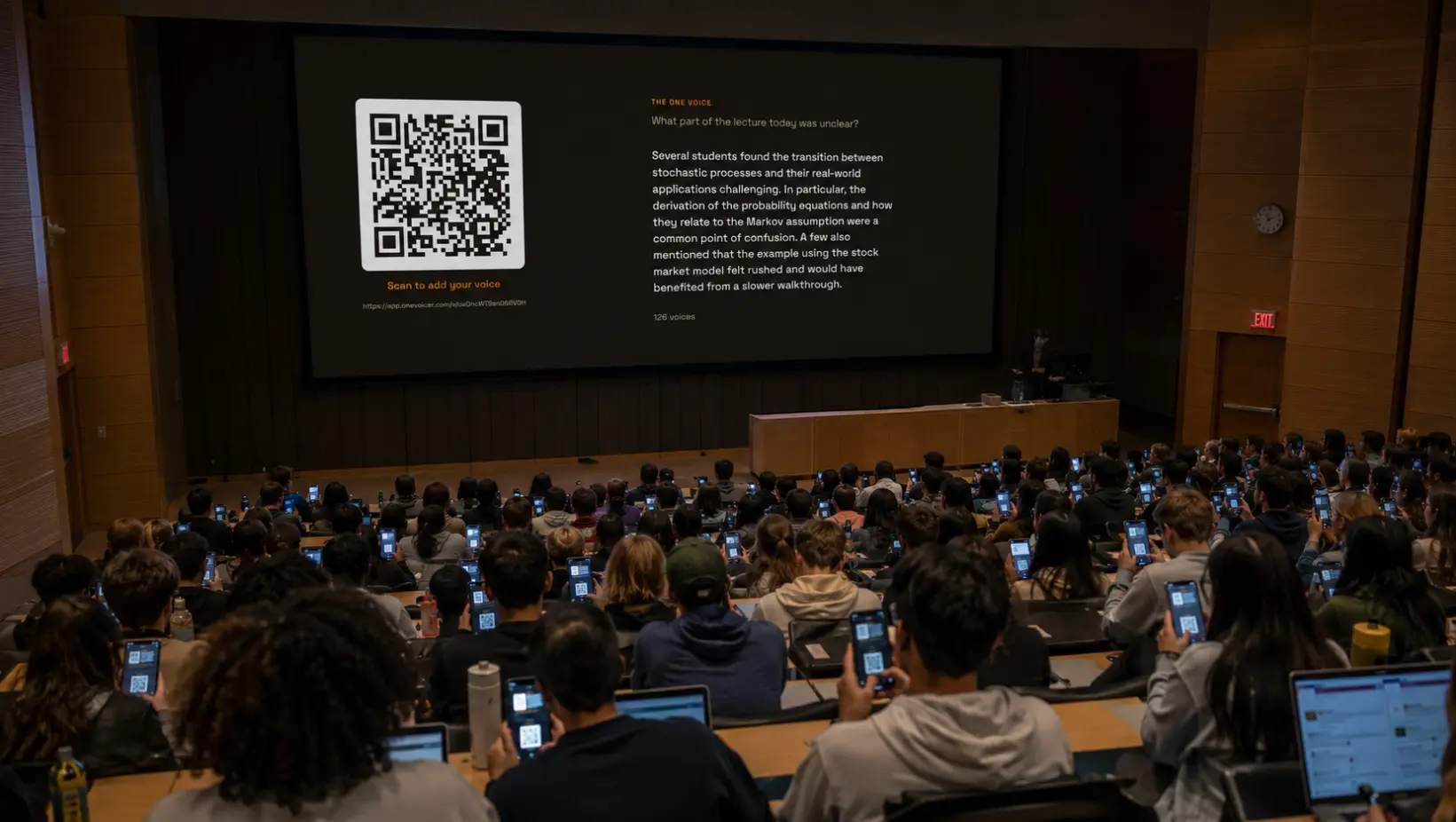
Every lecturer knows the moment. You finish a hard section, look up at two hundred faces, and ask “any questions?” Three seconds of silence. The same two or three hands that always go up, go up. Everyone else looks at their laptop. You take the silence as understanding, move on, and find out at the midterm that half the room got lost forty minutes in.
The silence is not evidence that the material landed. It is a property of the room. Fifty years of classroom research says participation in college classes concentrates in a tiny group of students while the majority never says a word, and that the fear keeping them quiet gets stronger as the hall gets bigger. Improving engagement in a large lecture is not about better cold calls or more charisma. It is about giving the other hundred and ninety students a way to answer that does not require raising a hand in front of everyone.
# The same six hands, every lecture
Sociologists David Karp and William Yoels sat in on college classrooms in the 1970s and put a name on what every lecturer has felt: the “consolidation of responsibility.” In their 1976 study in Sociology and Social Research, a small handful of students, two to five, accounted for the majority of everything said by students in class, between half and three quarters of all interactions. The rest of the room had quietly agreed, without anyone saying so, that talking was someone else’s job.
The finding has been replicated for decades. Jay Howard and colleagues, observing college courses through the 1990s, found it had gotten sharper, not softer: in their 2000 study in the Journal of Higher Education, a typical class session had six or seven “talkers” making almost 89% of all comments, and in their 1998 study over half of the students observed never spoke at all. And those were classes of 33 students or fewer. The pattern you see from the podium of a 200-seat hall is that pattern, scaled up.
# Silence is not comprehension
It would be comforting to believe the quiet students are quiet because they have no questions. The research says otherwise. When Howard and Baird surveyed students in 2000 about why they stayed silent, the non-talkers’ answers were not about mastery. The most common reason was “the feeling that I don’t know enough” (48.8%), and nearly half of non-talkers (47.1%) said they held back because they might “appear unintelligent to other students,” versus 13.2% of the students who did talk.
Cooper, Downing and Brownell interviewed students in large-enrollment science courses in 2018 and found the same engine underneath: fear of negative evaluation, the worry about looking dumb in front of a room full of peers, was the primary driver of anxiety about speaking up. In other words, the students who most need to ask a question are precisely the students least able to raise a hand. The lecture hall filters questions by confidence, not by confusion.
# “Any questions?” does not fix it, and cold calling makes it worse
The standard tools attack the silence from the wrong end. Asking “any questions?” invites exactly the public exposure the quiet students are avoiding, so it harvests the confident few and mistakes everyone else for satisfied. Cold calling attacks the symptom harder: it does produce a voice from row 30, but at a cost the research is blunt about. In the 2018 Cooper study, 59.6% of students said being called on without volunteering increased their anxiety; not a single one said it decreased it.
England, Brigati and Schussler measured the same thing across three introductory biology courses in a 2017 PLOS ONE study, asking 327 students to rate how anxious each classroom practice made them. Cold calling scored highest of every practice measured, 3.68 on a five-point scale. The lowest score, 2.73, went to clickers, the anonymous ones. That gap is the whole story: the less publicly exposed the answer, the more of the room you hear from.
# The bigger the room, the quieter it gets
Class size is not a neutral backdrop to all this. In Howard and Henney’s 1998 observations, class size was the single largest predictor of whether students participated, and the effect ran negative: more seats, less talking. Their largest observed class held just 33 students, and the authors wrote that they could only speculate how much stronger the effect would be in lectures of a hundred or more.
Newer work in actual large-enrollment courses supplies the answer. Nadile and colleagues surveyed 417 undergraduates at a research university for a 2021 PLOS ONE study and found that 47.7% reported never asking a question in their large science courses, not rarely, never, across an entire semester. About the same share (47.5%) never voluntarily answered one. And the silence is not evenly distributed: women were 2.4 times more likely than men to report never asking a question. A large lecture does not just mute the room, it mutes some students more than others.
The dynamic is not unique to lecture halls. Anyone doing large group facilitation, a workshop, an offsite, a training session, fights the same arithmetic: the bigger the group, the smaller the share of it you ever hear from, unless the input goes parallel.
# Engagement is worth real grade points
It is tempting to file all this under classroom ambience, until you look at what engagement is worth. Freeman and colleagues meta-analyzed 225 studies of undergraduate science, engineering, and math courses in a 2014 PNAS paper, comparing traditional lecturing with active learning, the family of techniques that make students respond during class. Active learning raised exam and concept-inventory performance by roughly 6% on average.
The starker number is the failure rate: 21.8% of students failed under active learning versus 33.8% under pure lecturing, which the authors summarize as students in traditional lecture courses being 1.5 times more likely to fail. Getting the room to respond is not a nicety layered on top of teaching. On the evidence, it is one of the highest-leverage instructional changes there is.
# Ask the whole room at once
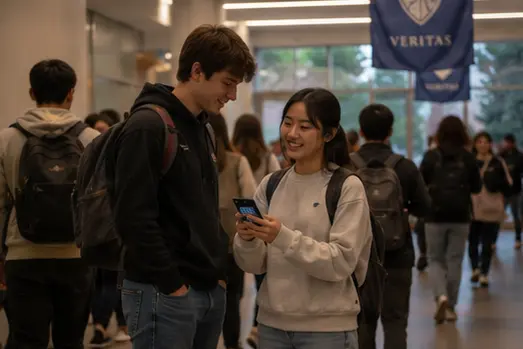
The fix follows directly from the diagnosis. If hands-up filters by confidence, replace it with a channel where answering costs nothing socially: one open question, put to the entire hall, that every student answers from their own seat on their own phone. Not multiple choice, words. “What part of today was unclear?” asked plainly, in the last few minutes, catches the confusion while it is fresh and from the students who would never say it out loud.
This idea has a distinguished ancestor. Frederick Mosteller, a Harvard statistics professor, wrote in 1989 about ending every lecture by asking students for “the muddiest point,” collected on index cards in the final three or four minutes of class. The cards worked because they were cheap to answer and safe to be honest on. A QR code on the closing slide is the same move without the card sorting: students scan, type a sentence, and are done before they finish packing their bags.
Anonymity is what makes it work, and this is measurable: Caldwell’s 2007 review of classroom response systems reports students saying they were twice as likely to attempt an in-class problem when answers were anonymous rather than by a show of hands. Anonymous by default is the right setting here; if you need one verified answer per student, for participation credit or a per-student pulse, requiring sign-in is a Creator plan option.
# Two hundred answers, one clear read
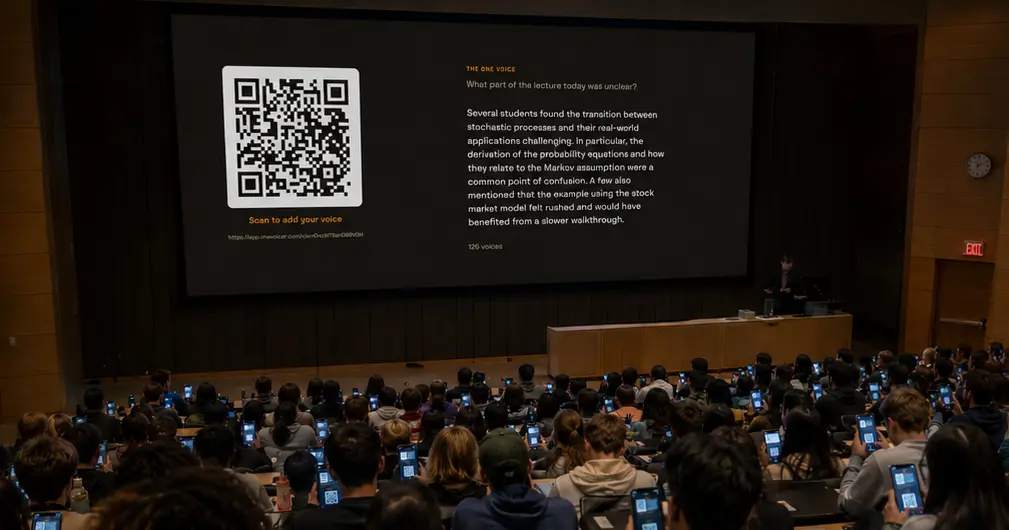
Collecting two hundred honest sentences creates the professor’s version of a problem every feedback system hits: nobody has time to read them. This is where OneVoicer changes the economics. Every reply feeds a single blended answer, the “one voice” of the class, a short paragraph that says what the room as a whole found unclear, updating live as answers arrive. By the time the hall empties, the read on the lecture is already written.
You can leave the one voice on the screen as students answer, which has its own effect on the room: students watch their collective confusion take shape in real time, and the professor stands in front of the most honest course evaluation there is. If you lecture from PowerPoint, the OneVoicer add-in puts the question, the QR code, and the live blended answer directly on your closing slide.
# A voicer per lecture becomes the record of the course
The habit compounds if you give each lecture its own voicer. Spin up a fresh one before class, same question every time, drop the QR code on the closing slide, and the semester quietly builds itself into a dated series: one voicer per lecture, each holding that day’s question, its blended answer, and every individual voice behind it.
That series earns its keep twice. Before the midterm, walking the list shows you exactly which weeks confused people, so review sessions target what the class actually struggled with instead of what you guess they did. And when you revise the course over the summer, you are not working from memory; lecture 14 told you, in the students’ own words, that the proof lost them at the second step. Course evaluations arrive months too late to help this semester. A voicer per lecture is the evaluation arriving while you can still act on it.
# The same habit in a seminar
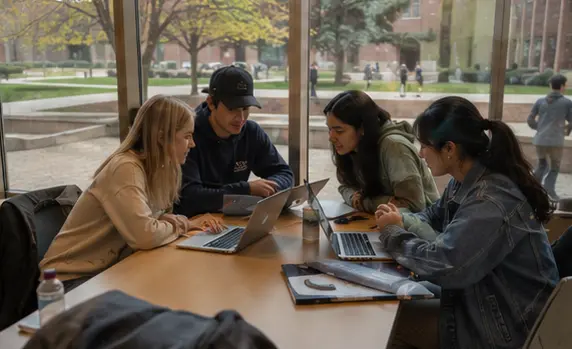
None of this is exclusive to the 200-seat hall; the mechanics just change size. In a twelve-person seminar the silence problem is smaller but not gone, and the standing question works better as a pre-discussion pulse: post the voicer with the reading, let everyone answer before class, and open the session with the one voice of what the group found difficult or contentious. The discussion starts from the honest middle of the room instead of from whoever speaks first.
The blend matters less at twelve voices, since you could read them all, but the anonymity still earns its keep. Even in a small room, the student who found the reading impenetrable rarely volunteers that with their name attached. The same question that unlocks a lecture hall unlocks a seminar table.
# A lecture-hall listening habit, start to finish
One question, three minutes of class time, and a five-minute read afterward. Here is the whole routine.
- Pick one question Mosteller’s classic still wins: “What part of today was unclear?” Keep the same wording all semester so answers are comparable from lecture to lecture.
- Make a voicer per lecture Create a fresh voicer before each class with that day’s date. The semester becomes a dated series you can walk back through, one blended answer per lecture.
- Put the QR code on your closing slide Give it the last three minutes, Mosteller’s timing. Students scan and answer from their seats, anonymously, before they pack up. No app, no account. If you lecture from PowerPoint, the OneVoicer add-in puts the QR code and the live answer on the slide for you (see the add-in guide under Keep reading).
- Read the one voice before the next lecture One short paragraph tells you what the room found muddy. Reading it takes a minute; deciding what to do with it takes five.
- Open the next lecture with the answer Spend the first five minutes clearing up the muddiest point by name. Students learn their answers change the course, which is what keeps them answering.
# Frequently asked
Do students need an app or an account to answer?
No. Students scan the QR code and answer in their phone browser, with nothing to install and no sign-up. Answers are anonymous by default. If you want one verified answer per student, for participation credit or a per-student record, requiring sign-in is a Creator plan option.
Won’t anonymous answers just be junk?
Some will be noise; most will not. When dozens or hundreds of students answer sincerely, the blend reads the room and the jokes wash out of the one voice. You can also open the full list of individual voices and remove anything that crosses a line.
How is this different from clickers?
Clickers ask the questions you thought to ask, with the options you thought to offer, and hand you a bar chart. An open question surfaces the confusion you did not anticipate, in the students’ own words, and the blend turns those words into one readable answer. There is also no hardware: the phones are already in the room.
When in the lecture should I ask it?
The last three minutes, following Mosteller. Confusion is freshest at the end of class, and answering as they pack up costs students nothing. You can also leave the voicer open all lecture so questions land the moment they occur, and read the blend after class either way.
Will students keep answering all semester?
They will if answering visibly matters. The habit that sustains it is closing the loop: open each lecture by addressing the previous one’s muddiest point by name. When students see their three-minute answer steer the course, the response rate takes care of itself.
# References
- David A. Karp & William C. Yoels, “The College Classroom: Some Observations on the Meanings of Student Participation,” Sociology and Social Research 60(4), 421–439 (1976) · coined the “consolidation of responsibility”: a handful of students (2 to 5) account for 50–75% of classroom interactions (figures as restated by Howard & Henney, 1998)
- Jay R. Howard & Amanda L. Henney, “Student Participation and Instructor Gender in the Mixed-Age College Classroom,” The Journal of Higher Education 69(4), 384–405 (1998) · about five “talkers” made nearly 92% of interactions; over half of students never spoke; class size was the largest (negative) predictor of participation
- Jay R. Howard & Roberta Baird, “The Consolidation of Responsibility and Students’ Definitions of Situation in the Mixed-Age College Classroom,” The Journal of Higher Education 71(6), 700–721 (2000) · six to seven talkers made ~89% of comments; 47.1% of non-talkers feared appearing unintelligent to peers (vs. 13.2% of talkers); “the feeling that I don’t know enough” was the most common reason for silence (48.8%)
- Erika M. Nadile et al., “Call on me! Undergraduates’ perceptions of voluntarily asking and answering questions in front of large-enrollment science classes,” PLOS ONE 16(1): e0243731 (2021) · of 417 students surveyed, 47.7% never ask a question in large-enrollment courses and 47.5% never voluntarily answer one; women were 2.4x more likely to report never asking
- Katelyn M. Cooper, Virginia R. Downing & Sara E. Brownell, “The influence of active learning practices on student anxiety in large-enrollment college science classrooms,” International Journal of STEM Education 5:23 (2018) · fear of negative evaluation was the primary driver of anxiety about speaking; 59.6% said cold calling increased their anxiety, none said it decreased it
- Benjamin J. England, Jennifer R. Brigati & Elisabeth E. Schussler, “Student anxiety in introductory biology classrooms,” PLOS ONE 12(8): e0182506 (2017) · cold calling rated the most anxiety-inducing classroom practice (3.68 of 5); anonymous clickers rated the least (2.73)
- Scott Freeman et al., “Active learning increases student performance in science, engineering, and mathematics,” PNAS 111(23), 8410–8415 (2014) · meta-analysis of 225 studies: ~6% higher exam performance under active learning; failure rates 21.8% vs. 33.8%, students in traditional lectures 1.5x more likely to fail
- Jane E. Caldwell, “Clickers in the Large Classroom: Current Research and Best-Practice Tips,” CBE Life Sciences Education 6(1), 9–20 (2007) · students reported being twice as likely to attempt an in-class problem when answers were anonymous rather than by show of hands (citing Cutts et al., 2004)
- Frederick Mosteller, “The ‘Muddiest Point in the Lecture’ as a Feedback Device,” On Teaching and Learning: The Journal of the Harvard-Danforth Center, Vol. 3, 10–21 (1989) · the origin of the muddiest-point question, asked in the last three to four minutes of class (described in an MIT/CDIO teaching note)