What, So What, Now What, with 50 strangers in under five minutes
We ran the classic three-question debrief with strangers online. Here’s what happened.
What you’ll learn
- How each question can build on the last one’s answers
- What the group concluded at each step
- Why faster rounds change how you facilitate
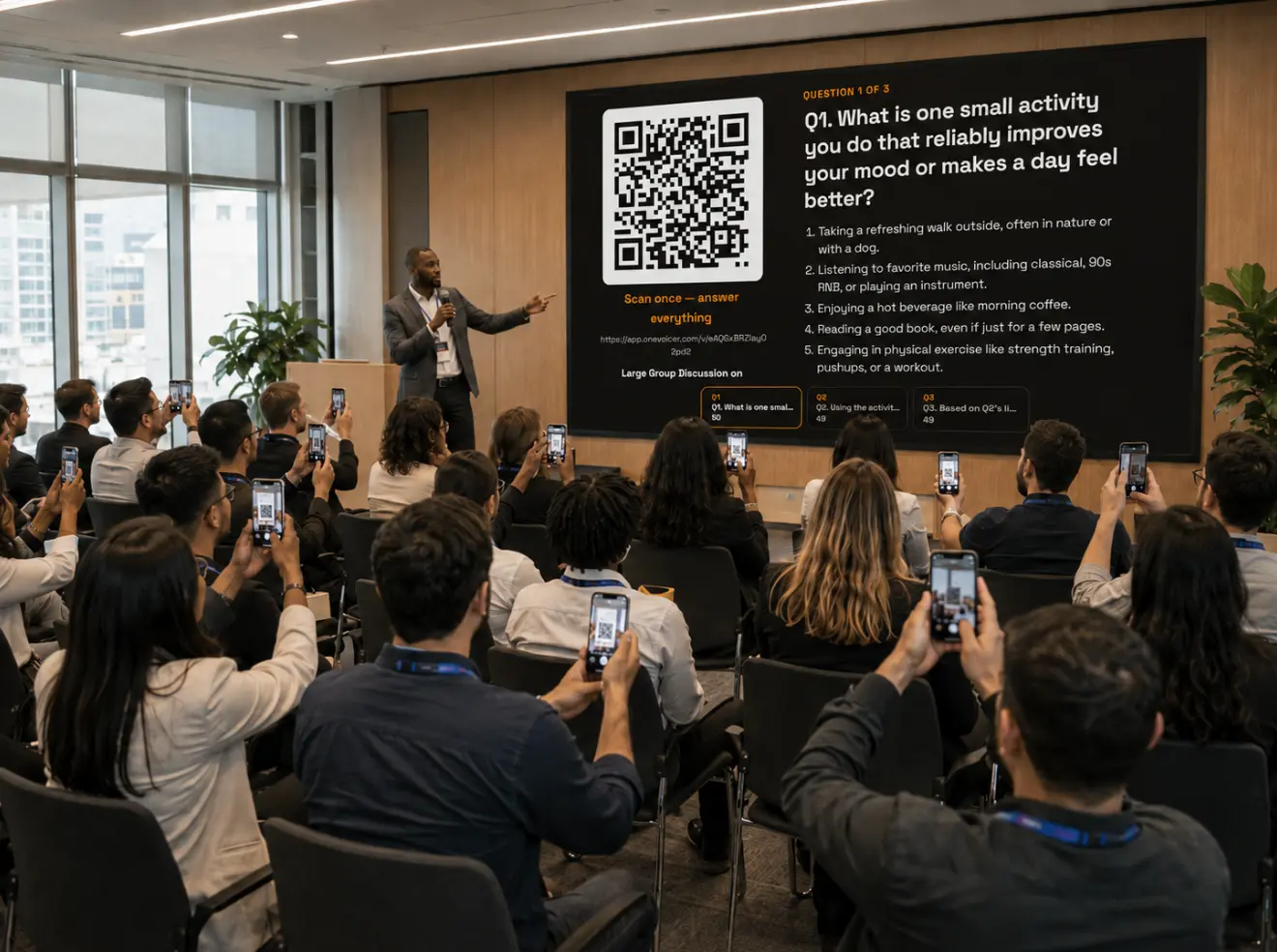
A divergent round with fifty people costs a wall of sticky notes. Making sense of the wall costs the break, or frankly the evening. And the convergent round usually happens at the next meeting, in front of whoever came back.
The arc itself has been standard since Terry Borton wrote it down in 1970: What, So What, Now What. What nobody has had is a way to run all three steps, with real synthesis in between, inside a single session.
So we ran a small experiment on ourselves: the three-question structure, three open questions about happiness, 50 strangers on Prolific, and each round building on a live blend of the round before.
To be clear about what this is: not a third-party case study, just us demonstrating our own product. Read it as a worked example, the questions we asked, the blends that came back, and what a facilitator can take from it.
# The study at a glance
- Panel
- 50 paid respondents on Prolific, arriving over about an hour.
- Topic
- Happiness: small activities that reliably improve a day.
- Structure
- Three open questions, What, So What, Now What, with answers capped at 280 characters.
- Delivery
- A OneVoicer group: one link, all three questions on a single scrolling page.
- Completion time
- 4:36 on average, from opening the page to entering the completion code.
# How the questions fed each other
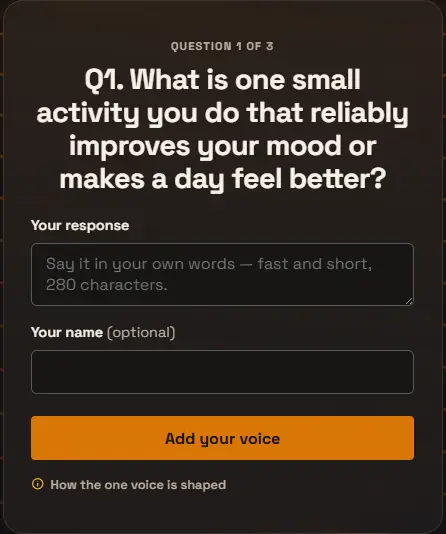
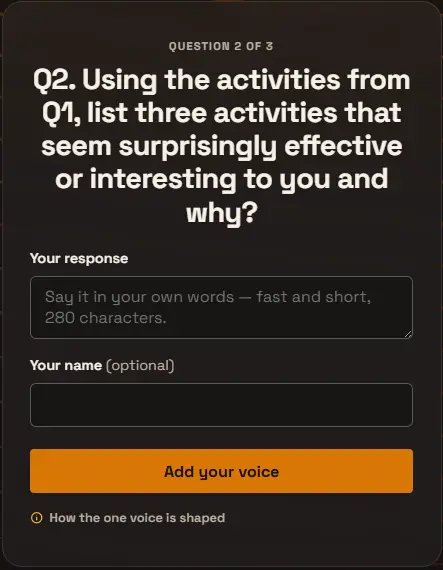
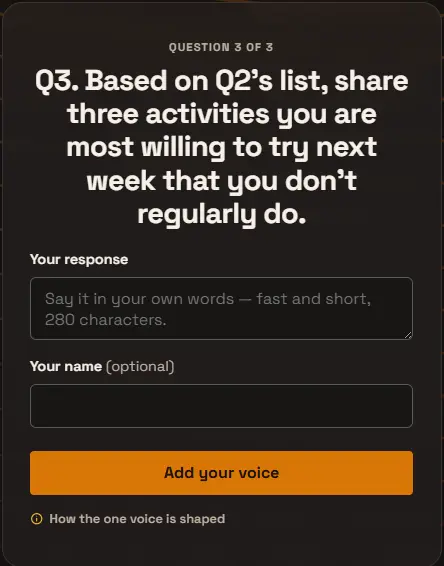
Every question in a group keeps its own one voice, a blended answer that re-forms as responses arrive, and a respondent sees it only after adding their own voice. That mechanic is what let the arc reference itself: the blend never waited for the crowd to finish, so by the time anyone reached question two, question one’s blend was already current, and “using the activities from Q1” was an instruction respondents could actually follow.
One honest caveat. This was not a facilitated room; each person walked the arc alone, at their own speed. In a live session you would orchestrate instead, taking questions live one at a time so the whole group crosses each threshold together.
How to run a survey with Prolific: our guide to the recruiting mechanics →
# The four-minute diamond
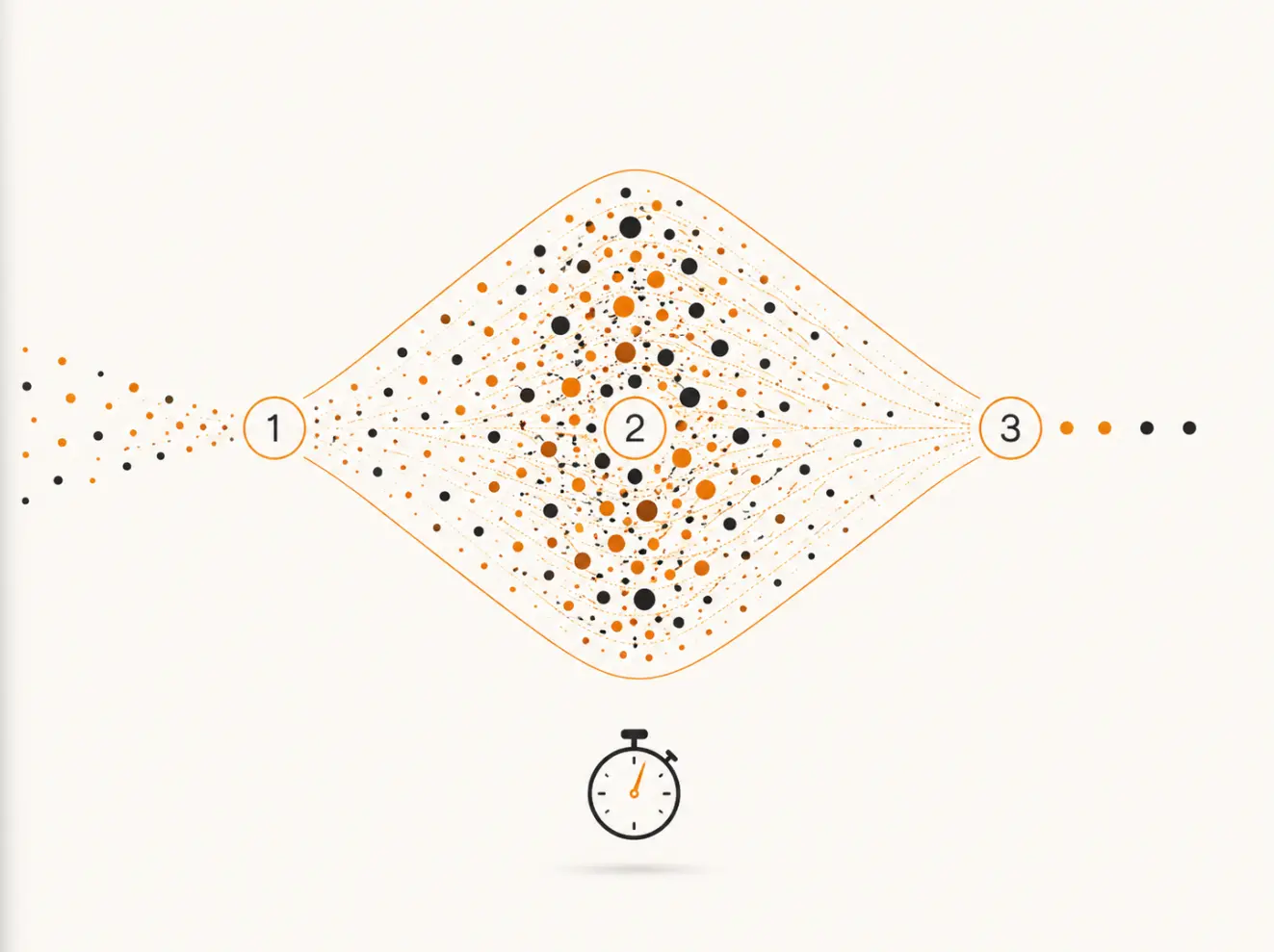
Facilitators will recognize the shape. Sam Kaner and his co-authors drew participatory decision-making as a diamond: divergence, then the groan zone where the group has to digest its own output, then convergence. Borton’s three questions map onto it cleanly, and Liberating Structures catalogs the mapping as W³, one of its most-used structures: What harvests, So What makes meaning, Now What commits. The expensive part has always been the middle, the stretch we called the synthesis gap when we wrote about facilitating with groups: someone has to read everything before the next round can build on it.
In this run, the gap simply was not there. The AI blends fifty answers faster than one person can read them, so the summary of everyone so far was already written whenever the next question needed it. That is the entire mechanism, and it is why the diamond compressed from two meetings into a few minutes.
The four-minute diamond: diverge, make meaning, converge, crossed by the average participant in 4:36, because the synthesis between steps was already done when they arrived.
# What: twenty ways a day gets better
Question one asked: “What is one small activity you do that reliably improves your mood or makes a day feel better?” The blend distilled fifty answers into roughly twenty recurring activities. An excerpt, verbatim:
- Walks
- Taking a refreshing walk outside, often in nature or with a dog.
- Music
- Listening to favorite music, including classical, 90s RNB, or playing an instrument.
- Coffee
- Enjoying a hot beverage like morning coffee.
- Exercise
- Engaging in physical exercise like strength training, pushups, or a workout.
- Loved ones
- Spending quality, intentional time with loved ones, family, or friends.
- Making things
- Practicing creative hobbies like painting, sculpting, or animation.
- Gratitude
- Engaging in quiet, mindful moments like reflecting on gratitude or saying affirmations.
# So what: the reasons arrived with the shortlist
Question two is the groan-zone move: “Using the activities from Q1, list three activities that seem surprisingly effective or interesting to you and why?” This is the round that normally goes home as the facilitator’s overnight homework. Here the room did its own sense-making, and the blend came back as a shortlist with the why attached to every line:
- Walking in nature
- Universally recognized for its grounding power, it clears the mind and offers a restorative connection to the outdoors.
- Listening to music
- Highly effective for shifting moods, whether by eliciting happiness, providing distraction, or energizing the listener.
- Cooking or baking
- Often described as a meditative, creative process that provides a tangible, enjoyable reward.
- Practicing gratitude
- A surprisingly effective, often overlooked method for shifting perspective toward the positive.
- Watching comedies
- Laughter is a powerful, accessible tool for shifting one’s mindset.
- Taking a nap
- A quick way to recharge and reset energy levels, though individual experiences vary.
# Now what: ten things to try next week
Question three converged: “Based on Q2’s list, share three activities you are most willing to try next week that you don’t regularly do.” Twenty divergent activities came back as ten themes with concrete first steps attached, and the list led with intentional breathing and mindfulness, an item that entered round one as a quiet, mid-list mention and climbed once people read each other’s reasons:
- Breathing and mindfulness
- Practicing gratitude, quiet reflection, being present, self-affirmations.
- Nature walks
- Walking in nature, going outside, touching grass.
- Learning new things
- Studying new skills, acquiring book knowledge.
- Movement and dancing
- Dancing, yoga, running, skating, sports.
- Cooking and baking
- Preparing meals, trying new recipes.
- Engaging with music
- Making music, listening to music, tapping to a rhythm.
- Artistic expression
- Creating art, painting, singing.
- Leisure
- Watching movies, reading, playing games.
- Social connection
- Talking to old friends, connecting with loved ones.
- Self-care
- Getting more sleep, taking naps, cleaning.
# Why seconds change the craft
Nobody runs What, So What, Now What end-to-end in one sitting today because every round of sense-making needs someone to read everything, and the room cannot wait that long. When the synthesis is faster than the crowd, that constraint goes away: you can write the next question in the moment, reacting to what the room just said, instead of guessing at it a week in advance.
In a room you would run this exact arc: build the three questions as a group, put one QR code on the projector, and take questions live one at a time so the whole room diverges and converges together, reading each blend aloud between rounds. It also makes a small, quick warm-up before breakouts: run the arc in the first fifteen minutes and every breakout table starts its discussion from a synthesized picture of the whole room.
Groups come with the Creator plan and up. Borton’s three questions have not changed since 1970. What changed is how long it takes fifty people to answer them together.
The Groups guide: bundling questions behind one link and QR code →
# Frequently asked
Did respondents see the blended answers before writing their own?
Not for the question they were answering. A respondent sees a question’s one voice only after adding their own voice, so each answer is written independently. The arc connects rounds the other way: question two’s wording sends people to question one’s finished blend, which they have already unlocked by answering it.
Can I run this arc live with my own group?
Yes. Build the three questions as voicers, bundle them in a group, and share one link or QR code. In Present mode you move the room question by question with the arrow keys, reading each blend aloud before advancing. Groups are included in the Creator plan and up.
# References
- Borton, Reach, Touch, and Teach: Student Concerns and Process Education, McGraw-Hill (1970)
- Lipmanowicz and McCandless, “What, So What, Now What? (W³),” Liberating Structures
- Kaner, Lind, Toldi, Fisk and Berger, Facilitator’s Guide to Participatory Decision-Making, 3rd edition, Jossey-Bass/Wiley (2014)