How we paid 100 strangers over 60 to share their biggest regrets, for $25.71
How to run a one-question survey with a paid audience, and get answers within the hour.
What you’ll learn
- Why one open question can beat a long survey
- How to find and pay an audience on Prolific
- What people over 60 regret most
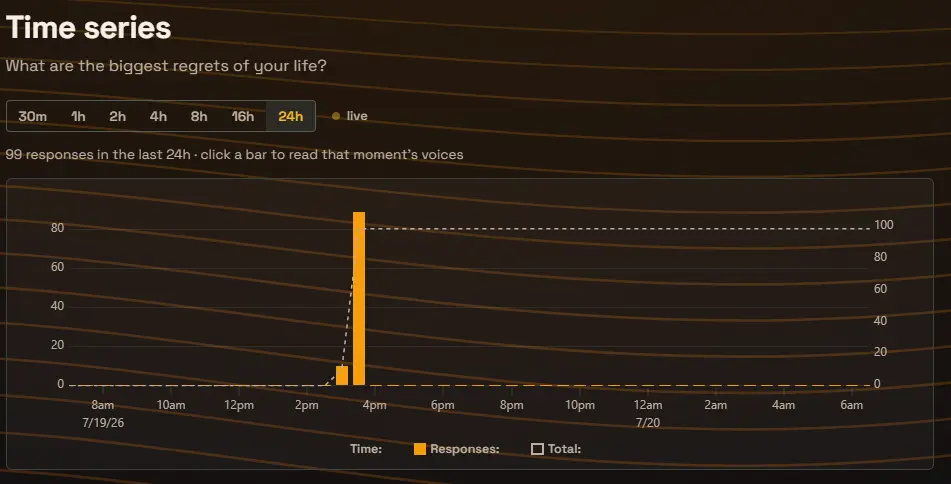
On a Sunday afternoon we asked 100 strangers, all over 60, a big question: “What are the biggest regrets of your life?” Within half an hour, 99 of them had answered in their own words, and OneVoicer had blended those answers into a single voice for the whole group. The entire study cost $25.71.
We ran it as an honest test of our own product and to document a workflow worth documenting: a paid research panel supplies the people, OneVoicer supplies the question, the collection, and the reading. What we got back was more than a test result. It was a hundred lifetimes of hindsight, handed over freely by people a few decades further down the road, and most of it reads like advice.
This is a how-we as much as a how-to: the setup, the one feature that makes paid panels work, the receipts, what 99 people regret, and what happened when we posted their answer on Reddit.
# Why one open question instead of a survey
Regret is one of the best-studied feelings there is. Palliative-care nurse Bronnie Ware’s “top five regrets of the dying” became a book and a small cultural institution, and Morrison and Roese’s 2011 study of a representative sample of Americans, in Social Psychological and Personality Science, found regrets cluster around love, education, and work, in that order. A multiple-choice survey would mostly have confirmed the checkboxes we wrote from that research.
An open box is a different instrument. It surfaces what you would never think to list: the pilot’s license never earned, the road trip not taken, the friend never called. The catch has always been the reading, because a hundred free-text answers is a spreadsheet nobody opens twice. That is the part OneVoicer removes: every answer is a voice, and the AI blends them into one answer that updates as new voices arrive.
Not rediscovering the joy of roller skating sooner.
One of the 99 voices
# Setting up the voicer
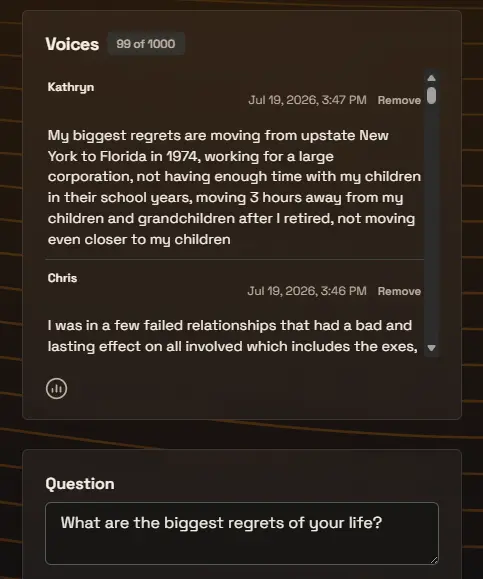
The OneVoicer side took a few minutes: a voicer with the question, anonymous responses with an optional name field, no sign-in. Answering is tap the link, type, submit. For a rented audience that friction level matters; every extra step is a returned submission.
# Renting an audience on Prolific
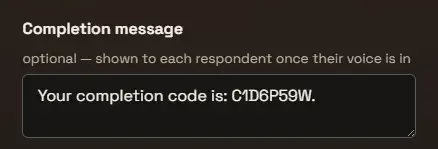
Prolific is a research panel: a pool of vetted participants who take studies for pay. We picked it on the strength of the data-quality literature; Peer and colleagues’ 2022 comparison in Behavior Research Methods found Prolific was the only platform of five that delivered high data quality on every measure without extra filtering. One feature carries the integration: Prolific pays participants when they enter a completion code, and OneVoicer’s completion message shows that code only after a voice is submitted. No answer, no code; every real answer, paid.
The screeners are where the meaning and the cost are decided. We asked for people over 60, because a question about life’s biggest regrets deserves answerers with a lot of life to look back on, and for English-first-language speakers anywhere rather than US residents only, which makes the pool larger, cheaper, and faster for a question with no geography.
Then the rate. We estimated the task at about a minute and priced it at 18 cents a response, an effective $10.80 an hour: above the $8 floor Prolific enforces, below the “at least $12” its guidance recommends and the $25 its setup screen suggested. Participants see the rate before accepting, and the study still filled in minutes. The receipt: $18.00 in rewards, $7.71 in fees, $25.71 all in. Call it 26 cents per lifetime of hindsight.
# The whole survey ran in half an hour
The chart at the top of this article is the fieldwork, complete: one spike between three and four in the afternoon. No fieldwork window, no waiting on a panel to cycle. We asked 100 people and 99 voices came back; one participant appears not to have finished submitting, a 99% return we will happily take. Watching the voices land live doubles as quality control, and ours were long, specific, and personal from the very first one.
My biggest regrets are moving from upstate New York to Florida in 1974… not having enough time with my children in their school years… not moving even closer to my children.
Kathryn, minutes after launch
# What 99 people regret
Here is how the one voice opened: “It seems many of us are looking back and wishing we’d made different choices, particularly around relationships and family. A significant number of us regret marrying too young or getting involved with the wrong partners… Many also wish they had prioritized spending more quality time with their loved ones, especially children and parents, lamenting that work often took precedence.” From there it moved through education and career paths not taken, risks not chased, and quieter currents of health, money, and children, wishing for more, or any.
Two things struck us. First, 99 rented strangers reproduced the published science almost exactly: relationships first, then education and work, the same ordering Morrison and Roese found. Second, and better, almost none of it reads as bitterness. Read together, the voices turn into instructions from people who have already run the experiment of a life: guard your time with the people you love, take the risk, make the call, trust your own voice. Hindsight is the one thing you cannot buy for yourself, and 99 people will apparently hand you theirs for 26 cents each.
I listened too much to others telling me what to do… not trusting my own inner voice.
One of the 99 voices
# Posting the answer where people could argue with it
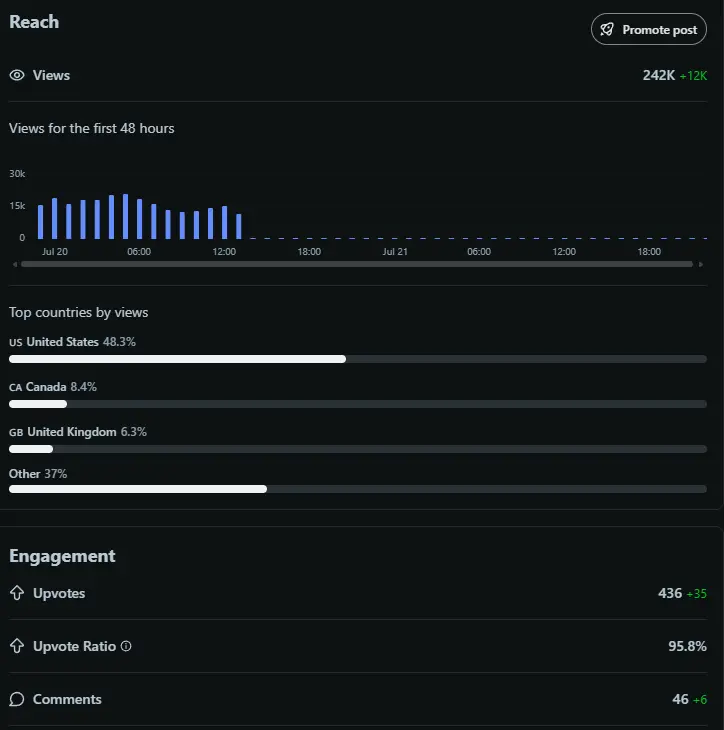
A result you keep to yourself is half a result, so we posted the blended answer to r/selfimprovement; the thread is linked in the references. In its first 48 hours it drew 242K views, 436 upvotes at a 95.8% ratio, and 46 comments, from readers across the US, Canada, the UK, and beyond. Even accounted purely as marketing, a quarter of a million views of a question your product answered is a strange bargain. The real reason to share is better, though: the whole point of borrowed hindsight is that other people get to borrow it too, and the comments told us they did.
# A commenter wanted a clearer format, so we changed it live
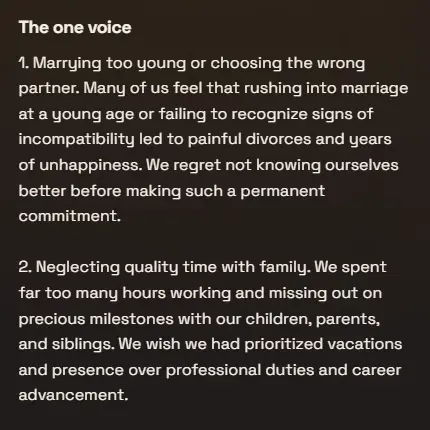
One commenter wanted more clarity than a flowing paragraph gives. With a traditional survey that means an evening re-coding a spreadsheet. Here it took one sentence in OneVoicer’s response criteria field: “Write the response as if it is a top ten list with the most common response being the lowest number.” The one voice re-blended itself into a ranked top ten, marrying too young at number one, neglected family time at two, while the question stayed live. From a reader’s complaint to a reformatted result took about a minute, and it is the part of this experiment no form-and-spreadsheet stack can follow.
I was a talented rock guitarist when I was younger and I regret not trying to make it big! I was too scared of criticism and tried to be too perfect.
One of the 99 voices
# Run your own $26 survey
One open question, a rented audience, about an hour end to end. Ours is the worked example; yours might ask a different hundred people who know something you need.
- Ask one question, answerable in a sentence Open-ended, so the answers can surprise you, and short, because with a paid panel you are buying minutes.
- Create the voicer and keep it frictionless Anonymous, no sign-in, optional name. A paid participant who hits a login wall is a returned submission.
- Put your completion code in the completion message It shows only after a voice is submitted, so the code that triggers payment is proof of a real answer.
- Build the study on Prolific Paste your voicer link and choose screeners deliberately; our over-60, English-first-language screen bought a longer view of life for less than a US-only sample. Estimate the time honestly and price at or above the platform floor.
- Watch the time series, then read the one voice Expect a spike, not a trickle. When it flattens, the blend is your result, with every individual voice underneath.
- Steer the format, then share the result If the paragraph should be a ranked list, say so in one sentence of response criteria. Then post the answer where the people it can help will find it.
# Frequently asked
Is $10.80 an hour a fair rate to pay participants?
It sits above Prolific’s enforced $8 an hour floor and below its recommended $12 and up, and participants see the rate before accepting. For a sixty-second task the absolute difference is 18 cents versus about 40. Our study filled in minutes; for longer or harder tasks we would price at or above the recommendation, both for ethics and because underpaid studies fill slowly.
What stops someone grabbing the completion code without really answering?
The completion message only appears after a voice is submitted, so there is no code without an answer. Low-effort answers are visible in the voices list and can be removed from the blend, and Prolific has its own process for submissions that do not meet the study description. In our 99 voices we did not find one we would call throwaway.
Why screen for people over 60?
Because the question was about a whole life, and we wanted answerers with most of one behind them. The screener is where a survey becomes intentional: the same $26 pointed at new parents, nurses, or first-year founders buys a completely different, equally specific pool of experience.
Is 100 answers enough to conclude anything?
Treat it as signal, not a census. What gave us confidence is that the themes independently reproduced the ordering in Morrison and Roese’s representative study: relationships first, then education and work. For questions where you currently have zero outside voices, 99 real answers for $26 clears the bar of “better than what you had” by a wide margin.
Could you not do this with Google Forms and a spreadsheet?
You could collect it that way; Prolific will point participants at any URL. What you would have afterwards is 99 paragraphs to read, code, and summarize yourself, and no way to reformat the summary short of redoing that work. The blend, the live time series, and the one-sentence reformat are the difference between running a survey and running an analysis project.
# References
- Morrison and Roese, “Regrets of the Typical American: Findings From a Nationally Representative Sample,” Social Psychological and Personality Science (2011)
- Peer, Rothschild, Gordon, Evernden and Damer, “Data quality of platforms and panels for online behavioral research,” Behavior Research Methods (2022)
- Prolific, “How much should I pay participants?” Researcher Help Centre (accessed 2026)
- Bronnie Ware, “Regrets of the Dying,” bronnieware.com (basis of the 2011 book The Top Five Regrets of the Dying)
- The results thread on r/selfimprovement (July 2026)