Facilitating with Groups: one QR code, a whole session
Run a whole session from one QR code, with every answer summed up live.
What you’ll learn
- Why making sense of answers slows every session down
- How three questions let the room set its own agenda
- How to go from many ideas to a decision in one sitting
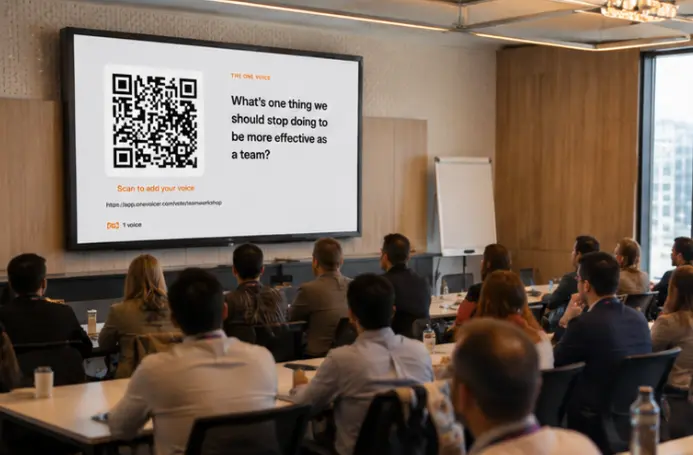
Groups are live in OneVoicer, and honestly, this is the release we have been most eager to put in facilitators’ hands. The feature itself is simple to say: bundle up to five voicers behind a single share link and QR code. The room scans once, answers every question on one scrolling page, and each question keeps its own one voice, the live blended answer that re-forms as responses arrive. The Groups guide in our docs walks through every control, from ordering the questions to the group’s own on and off switch.
This post is about the thing the bundling quietly unlocks: for the first time, a facilitator can run a real arc, several questions that build on each other, with synthesis happening between the steps, all inside one session. Ask, understand, ask again, while the group is still in the room and still cares, instead of collecting today and making sense of it next week.
To make that concrete we will run one example all the way through: opening a workshop by letting the room set its own agenda.
# Synthesis was always the bottleneck
The shape of a good participatory session has been mapped for decades. Sam Kaner and his co-authors drew it as a diamond in the Facilitator’s Guide to Participatory Decision-Making: a divergent zone where ideas multiply, a convergent zone where the group narrows toward a decision, and between them the stretch Kaner named the groan zone, where the room’s conflicting frames of reference have to become a shared understanding before any honest narrowing can happen. His claim is blunt: skip that stretch and the agreement you reach will not hold.
Here is the part the diagrams gloss over. Moving from divergence to convergence requires somebody to actually digest what the room just said, and until now that work could not keep up with a live session. So facilitators picked from a small handful of bad trades: end the meeting and affinity-map the wall overnight, which spends the group’s momentum; converge on a show of hands or a cluster of dots, which is fast precisely because it throws the reasoning away; or trust the facilitator’s own running summary, which is one person’s memory doing the work of forty people’s words. We call that stretch the synthesis gap: the time between hearing everyone and understanding everyone.
The collection side had a quieter problem too. Diehl and Stroebe showed back in 1987 that spoken brainstorming underperforms largely because of production blocking: only one person can talk at a time, and everyone else’s ideas decay while they wait their turn. Phones already fixed that half, since a room answering in writing answers simultaneously. What was missing was the other half: turning two hundred simultaneous answers into something the room can read together, in the minute or so before attention moves on. That is what per-question blending does, and a group strings those blends into a sequence.
The synthesis gap: the time between hearing everyone and understanding everyone. Every traditional escape from it either spends the room’s momentum or throws the reasoning away.
# Three questions that let the room set today’s agenda
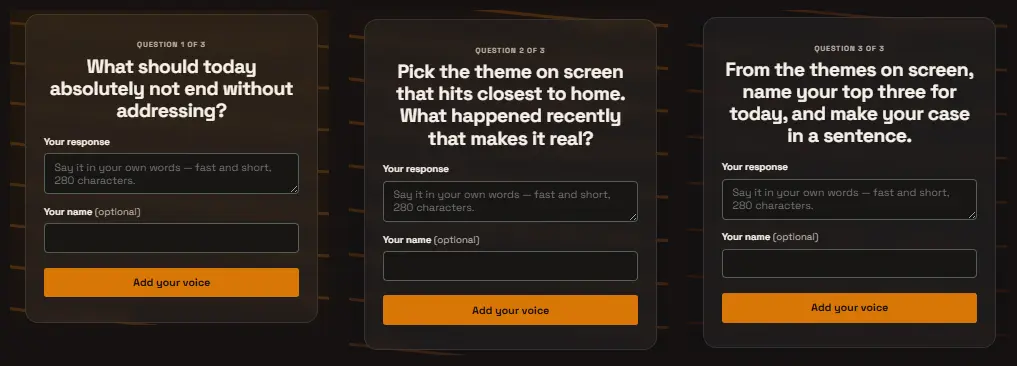
You planned this workshop weeks ago. The room walked in this morning knowing things you do not: what broke last sprint, which customer call went sideways, what everyone is actually worried about. The oldest facilitation move there is, ask the room what today should be about, has always died in the synthesis gap; you cannot affinity-map forty sticky notes while forty people watch you. So here is the same move as a three-question group, one QR code on the screen as people settle in.
Question one comes back in about a minute as a single readable answer naming the room’s real themes, three or four of them, on screen while everyone watches. No clustering, no transcribing the wall. Question two is the one facilitators will recognize as the craft move: before anyone ranks anything, the room grounds those themes in evidence. The blend of question two tells you which themes have fresh, concrete stories behind them and which turn out to be received wisdom nobody can actually instance. That distinction is exactly what a skilled facilitator digs for one hand-raise at a time, run for the whole room at once.
Question three asks for commitment with reasoning attached: a top three and the case for it. Because every voice is capped at 280 characters, the case stays tight, and the blend comes back as something no dot wall ever produced: the room’s focused agenda with the argument for it built in. You read it aloud, the room nods or objects, and the workshop starts on ground everyone already owns.
Two mechanics make the arc honest. A respondent sees a question’s one voice only after adding their own voice, so the divergent question stays genuinely divergent; nobody is polishing their answer to match the crowd. And a voicer’s question text is editable while it is live, so you can write question two’s wording in the moment, naming the actual themes question one surfaced.
- Q1, diverge
- “What should today absolutely not end without addressing?” The blend names the room’s themes while everyone watches.
- Q2, gather evidence
- “Pick the theme on screen that hits closest to home. What happened recently that makes it real?” The blend returns the weight of evidence behind each theme.
- Q3, prioritize with an argument
- “From the themes on screen, name your top three for today, and make your case in a sentence.” The blend returns a focused agenda with the reasoning attached.
The Groups guide: creating a group, ordering the questions, and going live →
# That was divergence and convergence in one sitting
Look at what just happened in Kaner’s terms. The room diverged, crossed the groan zone with an evidence round instead of a voting shortcut, and converged on a defensible set of priorities, in roughly the first twenty minutes of the session, with the group present for every step. That full arc is what used to span two meetings and an overnight synthesis in between, and the version that survived the gap was always thinner: attendance decayed, context evaporated, and whoever did the clustering quietly made a dozen editorial calls alone.
The agenda-setting opener is one arc among many. A retrospective is the same three beats: what happened, what mattered most, what do we change first. A discovery session with users, a community meeting working toward a shared position, a class deciding what to review before the exam, each is a sequence of open questions where every step deserves the previous step’s synthesis. Groups make the sequence a single artifact you design in advance and walk through live.
Convergence itself has more moves than we used here. Re-blending a single question through different lenses is its own craft, one we covered separately in our piece on how AI changes convergence in large group facilitation, and a group is simply the structure for chaining whichever of those moves your session needs.
# One QR code, and the stage walks with you
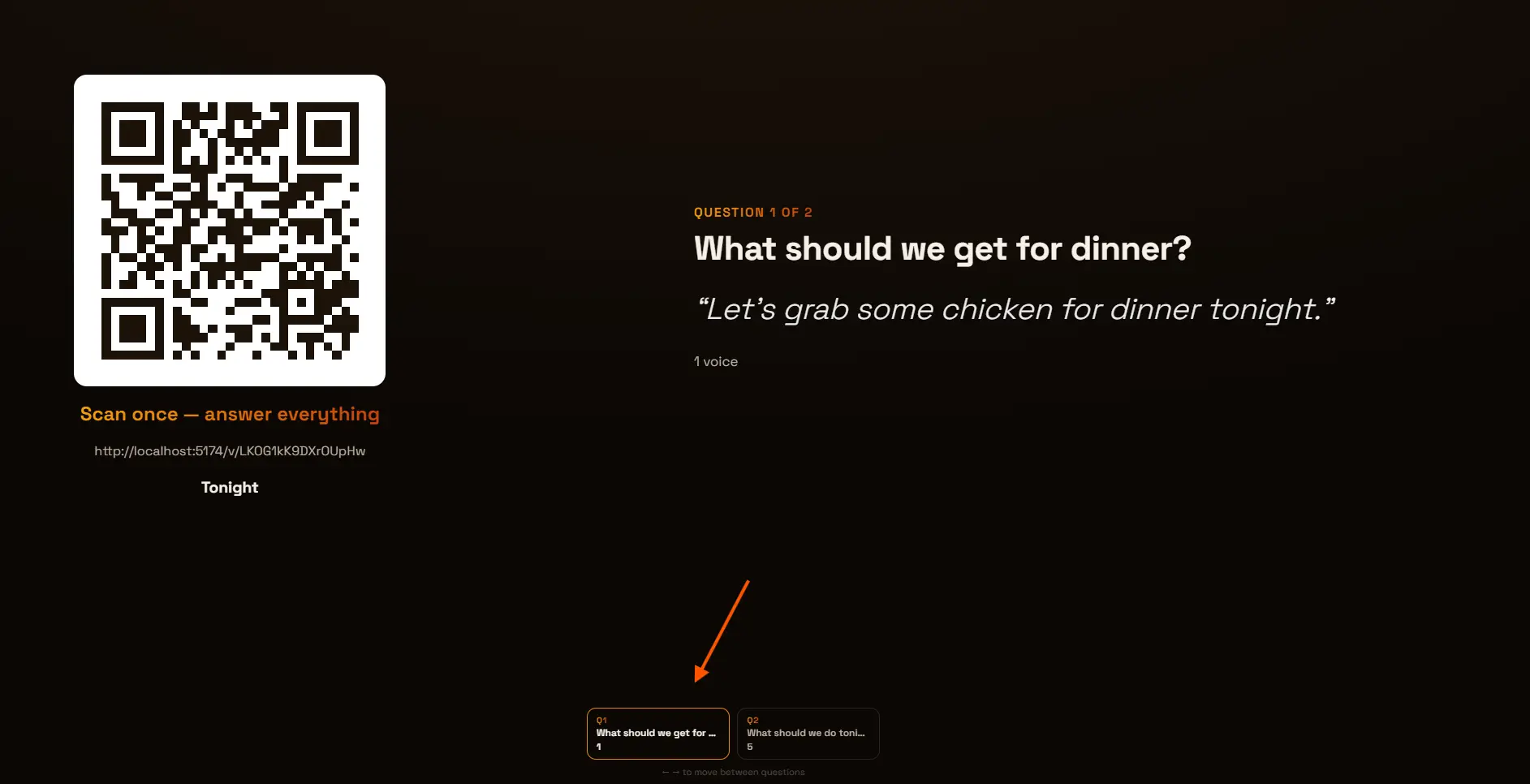
Presenting a group borrows a page from how musicians run a set list. The stage view puts one question at a time on the projector, its one voice re-blending live beside the group’s QR code, and the code never changes: people scan once at the start and keep the page open on their phones. The arrow keys move the room from question to question at your pace.
A strip along the bottom of the stage shows every question with a live count of its voices, which turns out to be a genuinely useful instrument: you can see answers piling up on question three while the room is still arguing with question two, which is the room telling you it is ready to move. On their phones, respondents get a progress count and answer at their own speed. The audience’s pace and the presenter’s pace stay decoupled, and that is what makes the arc feel like facilitation rather than a forced march.
# The facilitator still facilitates
None of this automates the job. The blend reads the room; it does not run it. Choosing the three questions, writing question two off the live themes, deciding whether the evidence round earned a longer argument, knowing when the room’s objection to a blend matters more than the blend, that is the work, and it is now the whole job instead of the part you did between bouts of transcribing sticky notes.
What groups change is the ceiling. A facilitator with real-time synthesis can honestly run the process the diagrams always promised: diverge, understand, converge, commit, one room, one hour, one QR code.
# Set today’s agenda with three questions
The opening arc from this article as a plan you can run at your next workshop, with the synthesis gap closed between every step.
- Build the group the day before Create three voicers: the divergent question, and working drafts of the evidence and priority questions. Bundle them in a group, in that order, and leave the group offline until the session.
- Go live and put the QR code up first Flip the group live and show its QR code as people arrive. One scan covers all three questions, so the room is enrolled before you say a word.
- Run the divergent question and read the blend aloud Ask what today must not end without addressing. Read the one voice to the room and name the themes it surfaced.
- Reword the evidence question live, then run it Edit question two so it names the actual themes on screen, then ask for the recent, concrete story behind whichever theme hits closest to home. Read back which themes carry real evidence.
- Ask for a top three with the case attached Run the priority question, read the blended agenda and its reasoning aloud, and ask the room what it gets wrong. Silence or small corrections both mean you can start the real work.
# Frequently asked
Why three questions and not five?
A group holds up to five voicers, but an arc needs a shape more than it needs length: open, ground, commit. Three questions run in about twenty minutes, with live discussion filling the space where the synthesis gap used to sit. Save the extra slots for sessions that earn them, like a retro that adds a temperature check at each end.
Does seeing the blended answer bias what people write?
Answers stay independent by design: a respondent only sees a question’s one voice after their own voice is in. The convergence in an arc comes from the next question referencing the last blend, which is the facilitator’s move, not from people watching the answer form before they commit.
Does this work for remote or hybrid rooms?
Yes. The group is one link, so remote participants get it in the meeting chat while the room scans the QR code, and everyone lands on the same page answering the same questions. The stage can be shared over the call the same way it goes on a projector.
What size group does this need?
The arc works from a team of eight to an audience in the hundreds. Small rooms get the synthesis without the awkward silence of everyone re-reading a wall; large rooms get the thing that was never possible, every voice in the blend regardless of who holds the microphone. Each voicer collects up to its plan’s response capacity.
Which plan includes groups?
Groups come with the Creator plan and up, with up to five voicers per group. Each voicer inside the group follows your plan’s normal limits. The Groups guide in the docs covers the details.