How AI changes convergence in large group facilitation
Every facilitator can fill a wall with ideas. The hard part is getting back out, and voting dots, familiar as they are, measure only one of the many ways a group can converge. AI just made the rest of them practical, live, in the room.
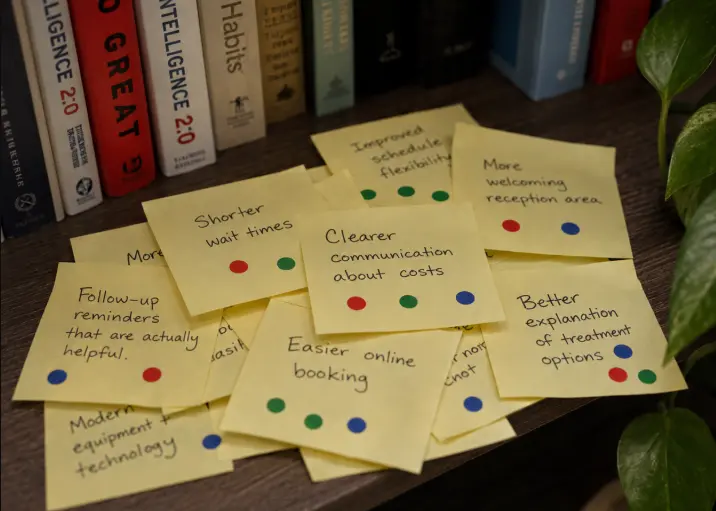
The last few times we ran a large group facilitation, the session ended the way so many do: a wall of sticky notes, clusters named, dots counted, photos taken. The pile of voted-on stickies went onto a bookshelf. It sat there for a year before anyone looked at it again.
That shelf is not a story about a bad session. The divergence was genuinely good: dozens of people contributed, the wall filled up, the energy was real. The failure came after, in the part of the process facilitators privately dread. Getting a large group to open up is a solved problem. Getting the group back out of the mess it happily made, with a decision everyone understands, is not.
This article is about that second half, and about a quiet assumption buried in it: that convergence means counting votes. It doesn’t. There are many legitimate ways for a group to converge, and until recently almost all of them were too slow to run while the group was still in the room. That is the thing AI actually changes for facilitators, and it is more interesting than another summarizing tool.
# The messy middle is where sessions go to die

The shape of a participatory session has been mapped for decades. Sam Kaner and his co-authors, in the Facilitator’s Guide to Participatory Decision-Making, drew it as a diamond: a divergent zone where ideas multiply, a convergent zone where the group narrows toward a decision, and between them the stretch Kaner named the groan zone, where conflicting frames of reference have to be worked into a shared understanding before any narrowing can honestly happen. His blunt claim is that sustainable agreements are nearly impossible without going through it. The Design Council’s double diamond, first published in 2005 and updated in 2019, encodes the same rhythm for design work: diverge, converge, twice over.
Notice the economics of the two halves. Divergence tools are fast and energizing: brainstorming, brainwriting, 1-2-4-All, sticky-note storms, silent ideation, and the wall fills up. Convergence has good tools too, affinity mapping, prioritization matrices, gradients of agreement, dot-voting, but they cost more time and more of the room’s energy, and they arrive at the tired end of the session. The groan zone, the part Kaner says the whole outcome depends on, is where the clock and the group’s stamina run down together.
Sustainable agreements are nearly impossible without staying in the groan zone until conflicting frames of reference become a shared framework of understanding.
After Sam Kaner, Facilitator’s Guide to Participatory Decision-Making
# Dot-voting is a convergence model, not the convergence model
When the clock forces the issue, dot-voting is often the tool within reach, and it is worth being precise about what dot-voting is: it is the consensus model of convergence. It answers exactly one question, “what does the plurality prefer?”, and it answers it while inheriting every social dynamic in the room. Nielsen Norman Group’s guidance on dot voting (Gibbons, 2019) names the failure modes facilitators already know by sight: persuaded voting, where one loud advocate drags dots behind them; split voting, where the top options tie and the exercise decides nothing; and group voting, where people put their dots where the dots already are.
The deeper problem is older than the dots. Stasser and Titus’s 1985 study in the Journal of Personality and Social Psychology showed that group discussion systematically favors information members already share and information that supports the preferences they walked in with. Groups in their experiments failed to surface the unshared knowledge that pointed to the objectively better option, and chose the initially popular one instead. Consensus methods do not just measure agreement; they manufacture it, by rewarding whatever was common knowledge before the session started.
None of this makes consensus useless. Knowing where the plurality stands is genuinely valuable, and sometimes it is exactly the question. The mistake is treating it as the only question. A room full of open-ended contributions can also be read for what the most experienced people said, what the newcomers noticed, what the evidence supports, where the functions disagree, what keeps causing everything else, and where the group is genuinely unsure. Each of those is a different convergence, from the same wall of input, and each can change the decision.
# The seven lenses of convergence
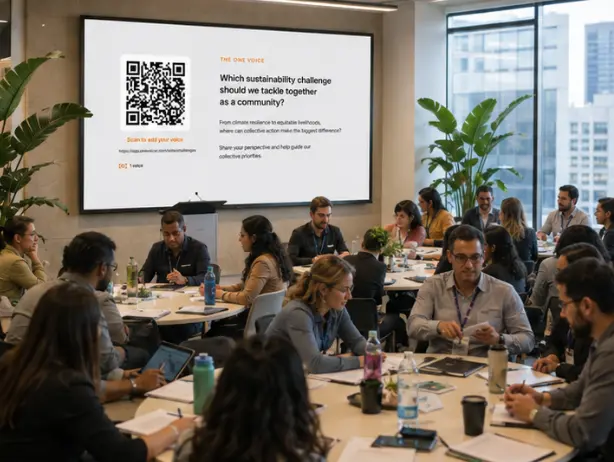
Here is the working set we keep returning to. Treat each one as a lens you hold up to the same pool of contributions, and note that each comes with a plain sentence a facilitator can state out loud, because in a moment that sentence is going to matter.
- Consensus
- What dot-voting approximates: the weight of common ground. “Blend toward the themes the most voices share, and say how widely each is held.”
- Expert opinion
- Some voices in the room have lived the problem. “Weight responses from people with direct, firsthand experience of this problem over general opinions.”
- Outsider observations
- Newcomers and outsiders see the water the fish can’t. “Give extra weight to perspectives from people newest to the group or outside the core team.”
- Evidence-weighted
- The counter to loud speculation. “Prioritize responses that cite specific examples, numbers, or firsthand events over general impressions.”
- Cross-functional
- A theme one department repeats is a complaint; a theme five departments repeat is a system. “Surface the themes that appear across multiple roles or teams, not just loudly within one.”
- Root-cause
- Groups love proposing fixes before agreeing on the disease. “Set aside proposed solutions and blend the responses into the underlying causes they point at.”
- Uncertainty
- Convergence isn’t always agreement; sometimes the honest output is the disagreement map. “Highlight where the group is split or unsure rather than where it agrees.”
# What AI actually changes: every lens becomes a sentence
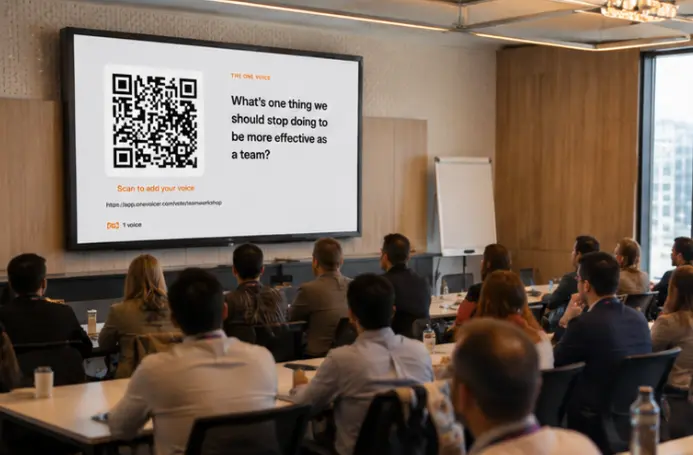
Every lens above has always been available in principle. In practice, each one meant somebody taking the wall home: transcribing stickies, coding themes, cross-referencing who said what, and reporting back days later to a group whose energy and context had already evaporated. That lag is why the shelf exists. The convergence models that need actual reading, rather than counting, cost an analyst-evening each, so the room runs the one model that can be executed with adhesive dots in four minutes.
This is the specific thing AI is unusually good at, and it is worth stating plainly because “AI for meetings” usually means transcription. A language model can read a hundred open-ended contributions and synthesize them under a stated rule, in seconds, and then read the same hundred again under a different rule. It does not get tired on response sixty. It has no favorites and no memory of who is senior. The marginal cost of a second reading, which used to be another evening, is now effectively zero, and that is what moves the other six lenses from the methodology books into the actual room.
This is exactly how OneVoicer is built to be used in a session. Everyone answers one open question from their phone, each answer becomes a voice, and the AI blends the voices into one answer on the screen, live. The blend defaults to consensus, faithful to the weight of what the group actually said. The convergence lens lives in the response criteria field: type “weight firsthand experience over general opinion” or “surface only the themes shared across teams” and the same voices re-blend under that rule, on the spot, in front of the group. Those plain sentences attached to each lens above are not decoration; they are, close to verbatim, what you type. Nobody re-answers anything. The facilitator asks the room which reading it wants next, and the groan zone turns from a slog into the most interesting part of the session.
The convergence models that need reading rather than counting used to cost an analyst-evening each. Now they cost a sentence.
# The facilitator is still the one facilitating
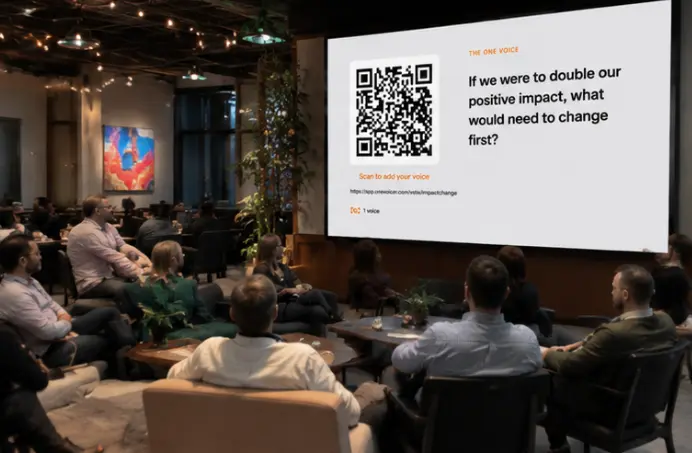
It would be convenient for us to claim the AI runs the session. It doesn’t, and the lens framework itself shows why. The model executes a convergence rule fast and without bias toward the loudest voice, but it has no idea which rule this moment needs. It cannot see that the energy dropped after the third theme, that the quiet half of the room is a different department than the vocal half, that the sponsor in the second row is anchoring everyone, or that this particular group needs its disagreement surfaced gently rather than projected on a wall. Choosing the lens is a judgement call made from context the model does not have, and it is the same judgement facilitators have always been paid for.
So the division of labor is clean. The AI is the fastest analyst you have ever worked with: it executes any convergence model you can state in a sentence, instantly, on the full set of voices. The facilitator is the orchestrator: choosing the question, reading the room, deciding which lens comes next, and judging when the group has genuinely converged rather than merely stopped talking. A blend can also be smooth in ways a facilitator should check; if the room was really split 50-50, the uncertainty lens should be run on purpose so the split is seen rather than averaged away. The tool removes the clerical reason convergence gets skipped. It does not remove the craft.
# Run the messy middle with lenses instead of dots
A convergence sequence for a large group session, using live AI blending. Budget about twenty minutes; the reading is instant, the reacting is the point.
- Diverge with one open question One question, answerable from a phone in a minute or two, no sign-in. “What should we stop doing?” beats a form with nine fields. Every answer becomes a voice.
- Read the consensus blend first Start from the default blend, the honest weight of what the group said. This is your baseline, the fair version of what dot-voting was trying to measure.
- Announce the next lens before you run it Tell the room, in one sentence, how the voices are about to be re-read: “Now weighted toward firsthand experience.” Stating the rule out loud keeps the process legible and the trust intact.
- Re-blend with one criteria sentence Type the lens into the response criteria field and let the same voices re-blend on screen. No re-survey, no coding, no evening with a spreadsheet.
- Let the group argue with each reading The lenses are conversation starters, not verdicts. The gap between what consensus says and what the evidence lens says is usually the most productive ten minutes of the session.
- Close on uncertainty, then decide Before converging on the decision, run the uncertainty lens once so the group sees where it is genuinely split. Then converge, with the record of every voice and every reading still on hand, instead of on a shelf.
# Frequently asked
Does AI-assisted convergence replace the facilitator?
No, and the framing matters. The AI executes convergence models fast and without social bias, but choosing which model the moment needs, reading the room, and judging when agreement is real are context and craft the model does not have. It replaces the analyst-evening, not the orchestrator.
What happens to minority views in a blended answer?
Under the consensus lens they carry proportional weight, same as any fair reading. The difference from dot-voting is that they are one criteria sentence from the center: an outsider lens or an uncertainty lens deliberately surfaces them, and every individual voice stays readable underneath the blend.
Can the group trust a blend it didn’t compute itself?
Trust comes from legibility: announce each lens before running it, show the individual voices behind the blend, and re-run a lens live if anyone doubts it. A stated rule applied by a model that has no stake in the outcome is easier to audit than dots applied under the gaze of the room, which Nielsen Norman Group’s dot-voting guidance (2019) notes are shaped by persuasion and bandwagon effects.
What if the room is genuinely split?
Then the honest output is the split, and the uncertainty lens exists to show it. A 50-50 room that leaves with a “decision” has not converged; it has deferred the groan zone to the follow-up meeting. Surfacing the disagreement cleanly is a better session outcome than averaging it away.
Is this only for big formal workshops?
The mechanics work anywhere people can scan a QR code: an all-hands, a community meeting, a meetup, a classroom. Large groups are where it matters most, because that is where reading every contribution by hand stops being possible and the shelf starts filling up.
# References
- Kaner, Lind, Toldi, Fisk and Berger, Facilitator’s Guide to Participatory Decision-Making, 3rd edition, Jossey-Bass/Wiley (2014)
- Design Council, “Framework for Innovation” (the Double Diamond, 2005; updated 2019)
- Gibbons, “Dot Voting: A Simple Decision-Making and Prioritizing Technique in UX,” Nielsen Norman Group (2019)
- Stasser and Titus, “Pooling of Unshared Information in Group Decision Making: Biased Information Sampling During Discussion,” Journal of Personality and Social Psychology (1985)