How to understand your customers at the farmers market
Learn what your customers think, without leaving the till.
What you’ll learn
- Why the busiest stalls learn the least
- How to ask a question anyone answers in ten seconds
- How to track what changes over the season
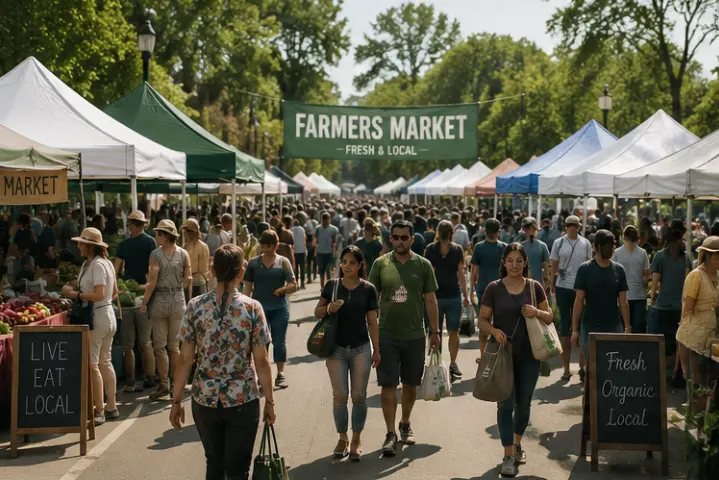
A farmers market stall is one of the highest-traffic, lowest-information businesses you can run. On a good morning a few hundred people drift past your table, pick things up, put them down, ask the price of the radishes, and move on. You take cash or a tap on a card reader, hand over a bag, and that is the entire record of the encounter. No name, no email, no receipt in an inbox, no idea whether the person buying tomatoes was here last Saturday or has never seen your stall before.
Every other kind of seller has more to go on than you do. A web store knows what people clicked and abandoned; a cafe with a loyalty app knows who its regulars are. You, with the busiest face-to-face channel of all, know the least. This guide is about closing that gap: the specific things a market vendor cannot see about their customers, and a way to start hearing them that keeps working while your hands are full of change.
# You are running blind, and the format is why
Direct-to-customer selling is not a fringe channel. The USDA’s 2022 Census of Agriculture counted more than 116,000 farms selling food straight to the people who eat it, some $3.3 billion worth, and its directory has listed close to 8,800 farmers markets nationwide. The pull for shoppers is well documented: a 2021 study in PLOS ONE found freshness is the single most important thing market shoppers look for, ahead of price, and US research has long found people choose markets to support local growers and to buy straight from the person who made the food. The irony is that the format built on a personal relationship gives the seller almost no way to remember it.
Think about what a single sale tells you. Online, it is a row of data: who, what, when, where they came from, what they nearly bought instead. At your table it is a coin and a smile. You cannot tell a first-timer from a tenth-time regular, you cannot count how many people considered the jam and walked on, and you cannot connect the slow Saturday to anything you could actually change. The relationship is the whole point of a market, and it is the one thing the transaction never records.
# The customers you most need to hear from already walked off
The feedback you do get is wildly skewed. The person who loved the peaches tells you they are the best of the summer. Everyone else just leaves. The shopper who thought your pint was overpriced does not argue the point, they drift to the next stall. The one who found the line too long, or could not tell what the green things were, or assumed you only took cash, says nothing at all. Most unhappy customers never complain. They simply do not come back, and you never learn why.
That silent majority is the most valuable audience at the market, and the hardest to reach. It is easy to believe you are doing great when the only people who speak up are the ones already sold. Bain & Company put a famous number on that blind spot in 2005: 80% of companies believed they delivered a superior experience, while only 8% of their customers agreed. A market stall is that gap in miniature, played out a few hundred times every Saturday, mostly in silence.
# The catch-22: the busiest stall learns the least
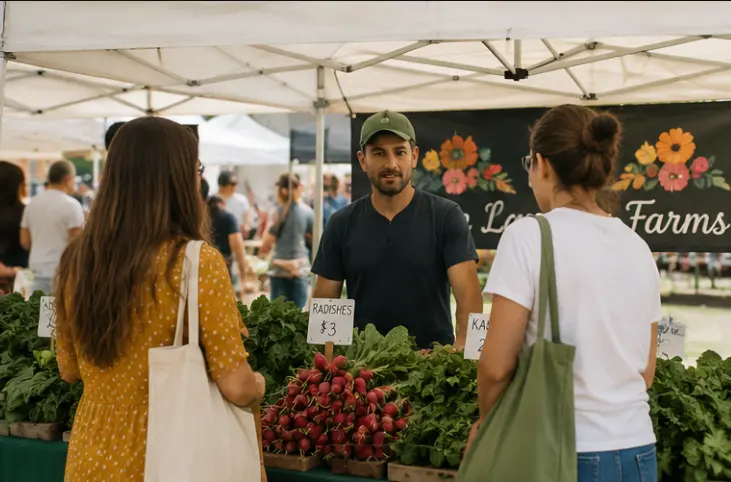
Here is the trap every vendor knows in their body. The moment you could ask a customer what they think is exactly the moment you have no time to do it. During the rush you are weighing, bagging, making change, and keeping an eye on the cash box, often single-handed. You cannot run a survey with your hands full. Then the crowd thins, you finally have a minute, and there is no one left to ask. The window when asking is possible and the window when it matters never overlap.
This is why the usual advice to “talk to your customers” quietly fails at a market. You are not avoiding the conversation, you physically cannot have it at the only time it would be representative. So the asking has to happen without you: something that invites every passerby to weigh in on their own, while you get on with selling, and hands you what they said once the day is done.
# Let the stall do the asking
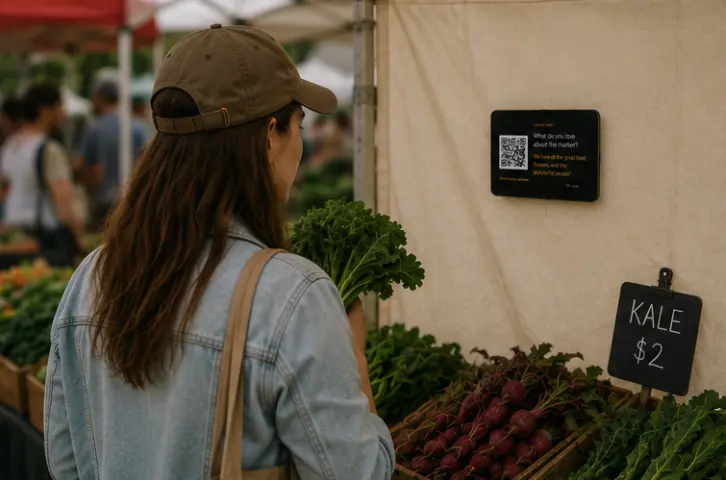
The cheapest version of this is a chalkboard. Write one question on the A-frame by your table, “What should we bring more of next week?”, and leave room for people to think about it. It costs nothing and it beats asking no one. But a chalkboard cannot capture an answer, so you are back to overhearing the few who say something out loud.
The upgrade is to make answering self-serve and to capture every reply. Prop a small screen or a tablet on the table, or pin a printed QR code to the stall, showing one question and an invitation to scan. People answer on their own phone, in their own words, in the few seconds they are standing in front of you deciding. No app to install, no sign-up, no line. It runs the whole market without your attention, which is the only kind of feedback collection that survives a Saturday rush.
And the gear costs almost nothing. A basic Android tablet runs about $40, and since a market stall rarely has Wi-Fi, you just connect it to your phone for an internet connection during the hours you are open. That is the entire setup: a cheap tablet propped on the table, sharing your phone’s signal, asking the question all morning while you sell.
# Ask one question anyone answers in ten seconds
Whether you use a board, a card, or a screen, the question makes or breaks the response rate. Ask one thing, in plain words, answerable in a sentence from a phone someone is already holding. A long form with ratings and boxes gets ignored at a market even more than it does online, because nobody stops their Saturday to fill one in. Keep it open-ended rather than multiple choice: a thumbs-up tells you the mood, but the words tell you why, and the why is what you can act on next week.
Pick the question to match what you actually need to decide. If you are choosing what to grow or make, ask about that. If sales are soft, ask the walk-by crowd what held them back. And keep asking the same thing for a few weeks so you can compare like with like, rather than rewording it every market and losing the thread.
- For the people who bought
- What made you stop at our table today? · What should we bring more of next week? · What is one thing you wish we sold?
- For the walk-by crowd
- What almost stopped you from buying today? · Was anything unclear, the prices, the products, how to pay? · If you ran this stall, what would you change first?
# Capture the “no,” not just the “yes”
The single most useful thing you can do is place the question where the people who did not buy will still see it. A board angled toward the aisle, a QR code on the edge of the table or on the back of your business card, a screen they pass whether or not they stop. The buyers will tell you plenty on their own. It is the near-misses, the ones who slowed down and moved on, whose reasons you have never once heard.
Anonymous is the right default here. People are far more honest about why they did not buy when there is no name attached and no salesperson watching them type. You are not after a clean headcount, you are after the shape of what people think, and a scan-and-type with no sign-up gets you the most candid version of it.
# A hundred replies, one clear read
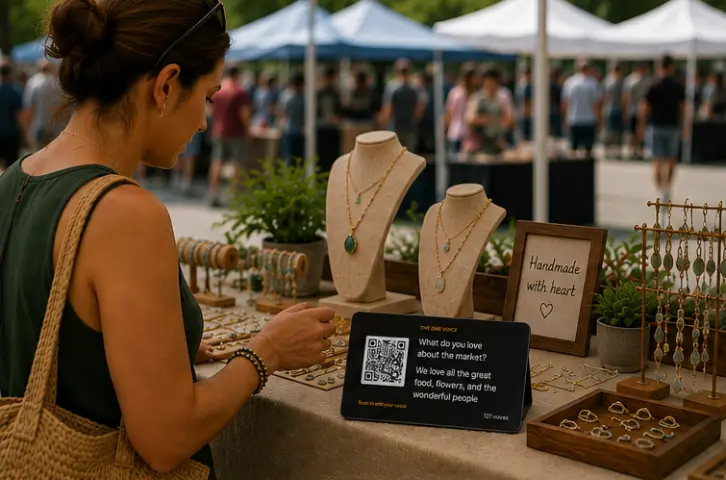
Collecting answers is the easy half. Reading them is where most feedback efforts die. A busy market can hand you a hundred short replies in a morning, and no vendor is going to sit down Saturday night and read a hundred comments, so the pile goes unread and the whole exercise quietly stops. The richest thing you have becomes the thing you ignore.
This is the part worth getting help with. Instead of a hundred separate notes, you want one short, faithful summary of what people said today: the recurring request, the common gripe, the thing people kept praising, in a paragraph you can read between customers. That is exactly what OneVoicer does with the replies to a question. It reads every voice and blends them into a single clear answer that updates as more arrive, so by the time you are packing up, the read on the day is already done.
# Track the season, not just Saturday
A single market tells you about a single day, and a single day at a market is mostly noise. Sales swing on the weather, a holiday weekend, a competing market across town, who else showed up. To learn anything you need each week saved so you can read the trend instead of the last data point. Save a weekly snapshot of the blended answer and over a season you build a dated history: a short, distilled read for each market, stacked so you can see what is actually changing.
That is the difference between guessing and knowing. “Sold out” might mean a product is your most-wanted, or it might mean you under-stocked it, and only a run of weeks tells you which. What you measure consistently, you can manage. The idea is old: Frederick Reichheld argued in Harvard Business Review back in 2003 that one number, tracked faithfully over time, beats a binder of one-off survey results. A season of weekly summaries is that kind of measurement, in a form you can actually read.
# Close the loop so they come back
The last step is the one most vendors skip, and it is the cheapest loyalty you will ever buy. When people see that you listened, they come back to see what else changed. So tell them. A line on the chalkboard next week, “You asked for more heirlooms, they are back by the scale,” does more for repeat business than any punch card, especially when you have no email list to fall back on.
It does not have to be big. One thing people raised, one thing you changed, shown where the crowd can see it. Feedback that visibly goes somewhere keeps coming, and keeps getting more honest. Feedback that vanishes into a box trains people to stop bothering, which is how most stalls end up flying blind in the first place.
# Your first month at the market
You do not need a CRM, a loyalty app, or a quiet afternoon to start understanding your customers. You need one question and four markets of paying attention. Here is a simple way to run it.
- Pick one question Choose a single open question that matches a real decision you face, what to grow, what to price, why people walk by. Commit to it for the whole month so the weeks stay comparable.
- Put it where the crowd is Set a screen or a printed QR code on the table edge, angled toward the aisle so the walk-by crowd sees it too, not just the people already buying. Make scanning the path of least resistance.
- Let it run while you sell Do not work the question during the rush. The whole point is that it collects on its own while your hands are full. Glance at it when you get a breath, and keep selling.
- Read the blend, change one thing, say so After each market, read the one blended summary, pick the most common theme, and change one thing for next week. Then tell people you did. This is the step that keeps replies coming.
- Review the month At the fourth market, read the season so far end to end. Separate the one-off grumbles from the patterns that repeat, and let the patterns decide what you stock, what you price, and what you stop bringing.
# Frequently asked
How do I get a busy market crowd to actually scan a code?
Lower the friction and give a reason. Keep the question to one plain sentence, make sure no app or sign-up is needed, and place the code where people already pause, the table edge, the bag, the back of your card. Showing that you act on the answers, with a note next week about what you changed, is what turns a one-time scan into a habit.
Should the feedback be anonymous?
Usually yes. People are far more honest about prices, products, and why they walked on when there is no name attached and no one watching them type. You are reading for the shape of what customers think, not running an exact headcount, so anonymous gets you the most candid answers.
What if I only get a handful of replies a week?
That is still more than you have now. Even ten honest answers a market will surface a clear theme, and a summary blends five replies as cleanly as five hundred. Leave the same question up across several markets and the picture fills in as more arrive.
Do I need a screen, or is a printed sign enough?
A printed QR code on a card or the table edge is plenty to start, and costs almost nothing. A small screen or tablet showing the question and the live answer is a nicer draw and catches more of the walk-by crowd, but it is an upgrade, not a requirement. Start with paper and add a screen if it earns its place.
Can I ask buyers and walk-bys different questions?
Yes, and it is often worth it. Many vendors run one question aimed at buyers, like what to bring more of, and a separate one aimed at the people who did not stop, like what almost stopped you. Each is its own question with its own link or code, and you read each as its own summary.
# References
- USDA NASS, “2022 Census of Agriculture” (2024) · 116,617 farms sold directly to consumers, $3.3 billion in sales
- USDA Economic Research Service, “Growth in the number of U.S. farmers markets slows in recent years” (2021) · 8,771 markets in 2019
- Hakan Adanacıoğlu, “Factors affecting the purchase behaviour of farmers’ market consumers,” PLOS ONE (2021) · freshness as the top driver, buying direct from the grower
- USDA Economic Research Service, “Local Food Systems: Concepts, Impacts, and Issues” (ERR-97, 2010) · why shoppers choose local and direct
- Bain & Company, “Closing the Delivery Gap” (2005) · the 80% vs 8% customer experience gap
- Frederick F. Reichheld, “The One Number You Need to Grow,” Harvard Business Review (2003) · measuring what you can manage