Deep dive: a six-lens debrief in fifteen seconds
Get a full debrief of your room’s answers before the session ends.
What you’ll learn
- Why one summary hides disagreement and outliers
- Six ways to read a room’s answers at once
- How to check every finding against what people wrote
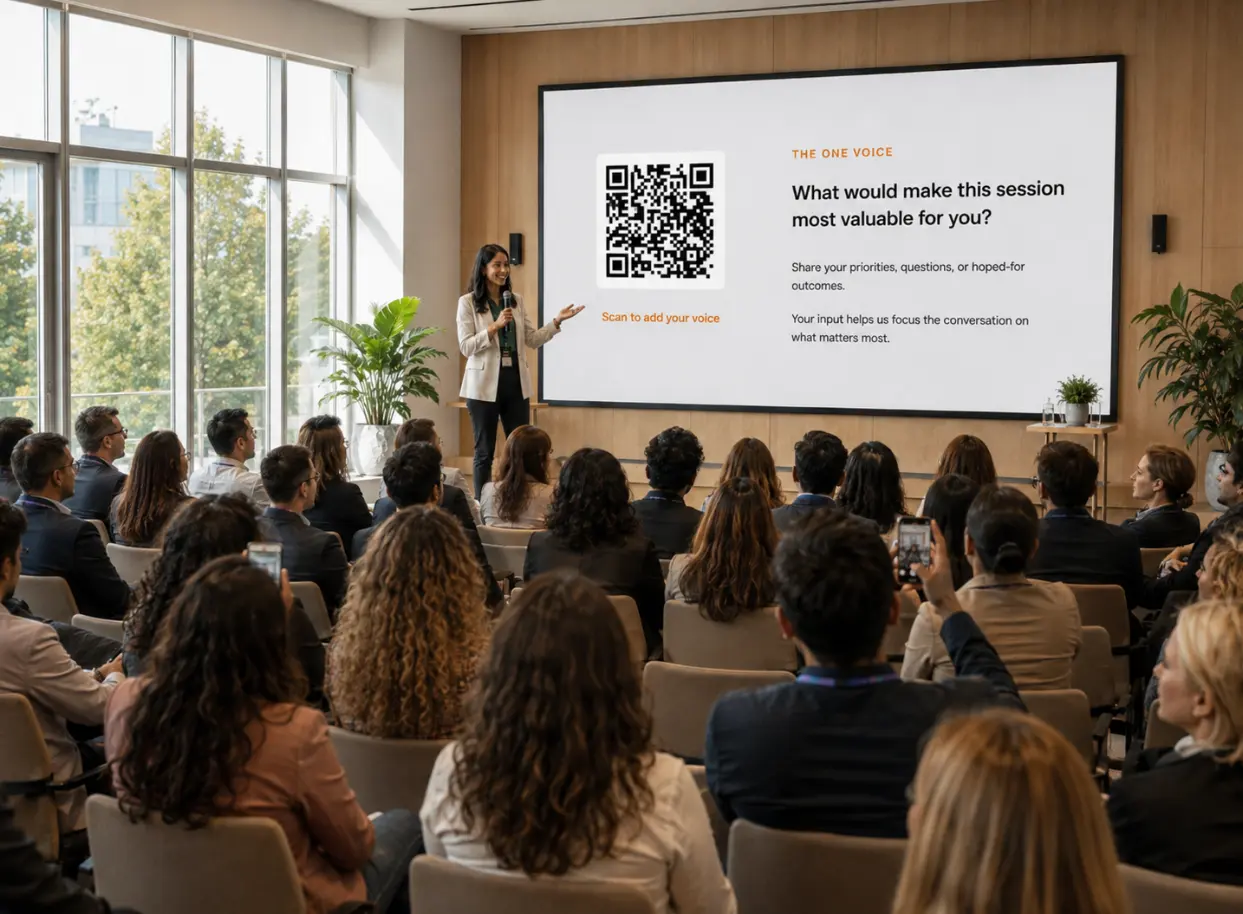
There is a moment near the end of every gathered-input session that facilitators recognize immediately. The wall is full, or the tool is full, forty or sixty real answers sitting right there, and the agenda has left you about twelve minutes to do something with them.
What the group deserves is a real debrief: where do we actually agree, what matters most, who said the thing everyone else missed. What the clock allows is a quick theming pass and a promise to send a summary around.
The craft for doing better exists, and facilitators already know it. Nominal group technique for honest ranking. A structured devil’s advocate for the counter-case. A deliberate pass for the quiet perspectives. Each one works, and each one costs a block of session time, so you pick one in advance, before you know which one this particular room will actually need.
We built Deep dive because that is a bad choice to have to make. It runs six of those analyses on the answers a room has already given, at once, each as its own card, each quoting the voices it stands on. This post is mostly about those six lenses, but since plenty of readers will be new here, first the thirty-second version of what OneVoicer is.
# The thirty-second tour: one question, one QR code, one voice
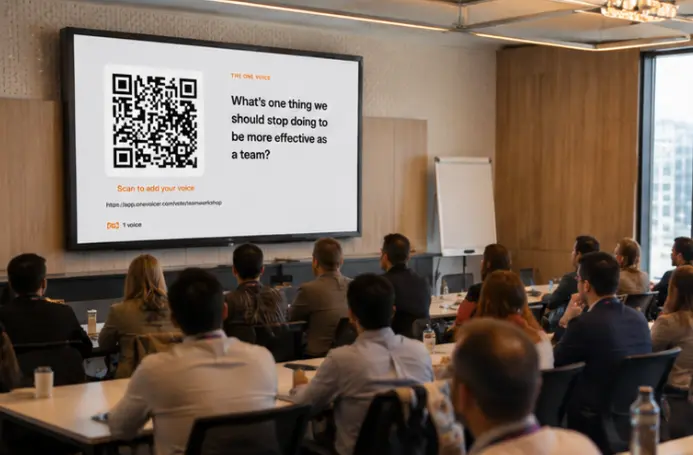
OneVoicer puts a single open question on the screen with a QR code. People scan it and answer on their phones, in their own words, no app and no account, and as answers arrive an AI blends them into one representative answer, the one voice, live in front of the room. Ask “what should we stop doing?” and instead of a word cloud or a wall of fragments, the room watches a paragraph form that reads like the group wrote it together.
It runs wherever the room happens to be:
- Stage view
- Full-screen for a projector, QR and live answer side by side.
- PowerPoint add-in
- The same live screen inside your slide deck.
- Stream overlay
- A rotating corner card for OBS and live streams.
- Embeds
- On your own site, WordPress included.
# The asker always sees every voice
One thing to hold onto before the analysis talk: the person asking sees every individual answer, always. The blend is a reading of the voices, never a replacement for them.
That single blended answer is the product’s front door, and for a lot of sessions it is honestly plenty. For a facilitated session, it is the warm-up.
# A blended answer is consensus by design, and consensus is one lens of several
A blend is built to answer “what did the room say, taken together?” That is genuinely useful and genuinely partial, and facilitators are the people least likely to be fooled about the partial part.
The whole discipline exists because groups left to their own devices converge too early: on the loudest framing, on the first plausible cluster, on whatever the group already believed on the way in.
We have argued the theory of this before, that a group’s answers deserve more than one reading and that AI makes additional readings nearly free. Those pieces showed the manual version: type a criteria sentence, re-blend, repeat with a different sentence. Enough facilitators ran that exact loop, the same handful of readings, session after session, that the conclusion became hard to ignore.
The readings worth running are not improvised each time. They are a fixed instrument, and an instrument should be one button.
The earlier argument: AI facilitation, don’t automate the facilitator →
# One button, six analyses, quoted evidence
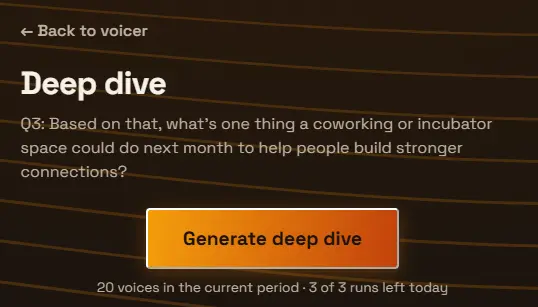
Deep dive is a button on the voicer that collected the answers. Press it and six analyses run over every voice in the current session, and the report assembles in front of you, card by card, usually in less than 15 seconds. Each card carries a headline that states its finding, a short analysis, and indented lines quoting the verbatim voices behind it.
The lenses are fixed, deliberately, in an arc that runs from agreement out to trade-off:
- Consensus
- Where do we actually agree, and how solidly?
- Priorities
- What matters most, ranked by frequency and intensity.
- Minority Voice
- The perspectives only a few voices carry, easy to lose.
- Dissent
- The strongest good-faith challenge to the prevailing view.
- Positive Deviance
- The outlier whose different approach looks like it works.
- Tensions
- The trade-offs the room cannot vote its way out of.
# Fixed lenses, and permission to find nothing
Fixed matters for the same reason your debrief formats are named and repeatable: a Dissent card means the same thing in every session, so a room that has seen one before knows how to read the next one.
A lens with nothing to find says so. A small room with unanimous answers gets a Dissent card that reports no real counter-voice yet, rather than a manufactured controversy. For a facilitator, whose credibility rides on the debrief, that matters.
# Consensus and Priorities: the counting you already trust, minus the dots
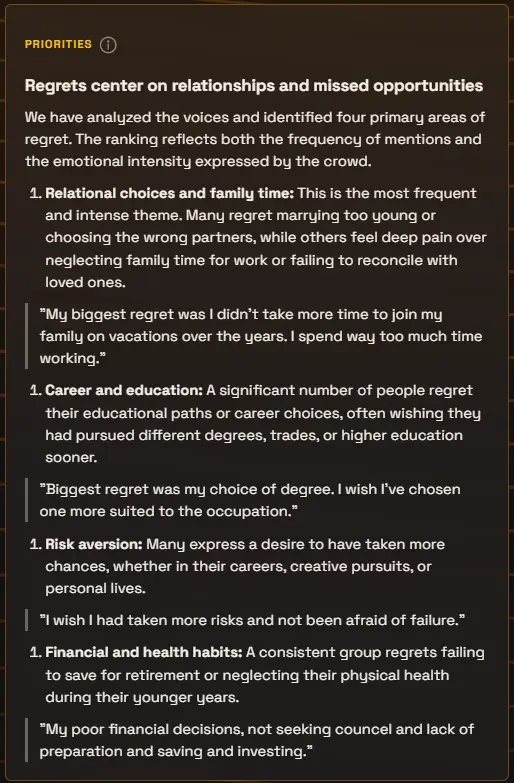
The first two lenses do the work facilitators usually spend dots and flipcharts on. Consensus states the common ground and grades how solid it is, unanimous versus most versus many, which is a distinction a show of hands flattens.
Priorities works the way nominal group technique has since Delbecq and Van de Ven formalized it in 1971: surface the distinct concerns, weigh how many voices raise each and how intensely, and produce an explicit ranking. The difference is that nobody had to run the rounds. The ranking arrives with a quoted voice under each item, so the room can immediately argue with it, which is the point of a ranking in a facilitated session anyway.
Delbecq & Van de Ven, A Group Process Model for Problem Identification and Program Planning (1971) ↗
# Minority Voice and Dissent: what rooms are built to lose
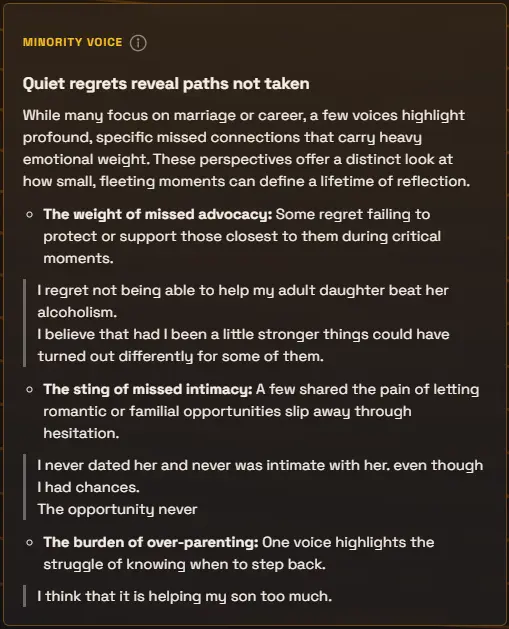
These two lenses exist because of the oldest findings in group psychology. In Asch’s conformity experiments, roughly 75% of participants went along with a group’s obviously wrong answer at least once. Janis spent a book, Victims of Groupthink (1972), on what cohesive groups do to their own dissenters, and every facilitation technique for protecting minority views, round-robins, silent brainstorming, anonymous cards, is a countermeasure to the same force.
Anonymous phone answers already remove the pressure to conform while speaking. What they do not fix is the debrief: a perspective mentioned by two voices out of fifty still vanishes the moment anyone summarizes, because summarizing is averaging. So these lenses read against the average, on purpose.
Minority Voice hunts for the perspectives only a few voices carry that add something real, lived experience the majority lacks, a consideration everyone else skipped, and gives them the floor in their own words. It is instructed not to manufacture significance: a view earns the card by what it adds, not by being rare.
Dissent goes further and builds the strongest good-faith case against the room’s own prevailing view, from the dissenting voices’ actual arguments, presented at full strength. A facilitator can assign a devil’s advocate; most skip it, because it needs a volunteer willing to be unpopular and time you do not have. The Dissent card runs the same move without asking anyone to wear the hat.
Asch’s conformity experiments (1951–1956), summarized by Simply Psychology ↗
# Positive Deviance: the outlier pass nobody has time to run
This one has the best origin story, and it comes from fieldwork, not software. In 1990, Jerry and Monique Sternin of Save the Children faced widespread child malnutrition in Vietnamese villages. Instead of importing a solution, they looked for the poor families whose children were nonetheless well nourished, and found their uncommon habits: tiny shrimp and sweet-potato greens added to meals, more frequent feeding.
They spread those local habits, and within months, malnutrition in the pilot villages had fallen by more than half. The approach eventually reached millions of families.
Almost nobody debriefs for this. It requires reading every single response while asking “who is the outlier that seems to be winning?”, which is precisely the kind of full pass a human never has time for and a machine always does. The card names what the outlier does differently and why it looks promising against what everyone else reported.
Positive Deviance Collaborative: The Vietnam Story, 25 Years Later ↗
Somewhere in your fifty answers there is often one person for whom the shared problem is somehow not a problem, and their answer explains why.
# Tensions: name the trade-off instead of voting past it
Tensions is the quiet sophisticated one. Barry Johnson’s Polarity Management (1992) drew the line facilitators still use between problems you solve and polarities you manage, and a room’s answers usually contain both. This card names the trade-offs: two things the same room clearly values that cannot both be fully had, grounded on each side with quotes, and deliberately left unresolved.
In practice it is the best bridge to “now what” a debrief can produce. Next actions negotiated inside a named tension survive the following week better than actions voted up while pretending the tension away.
# Every card shows its receipts
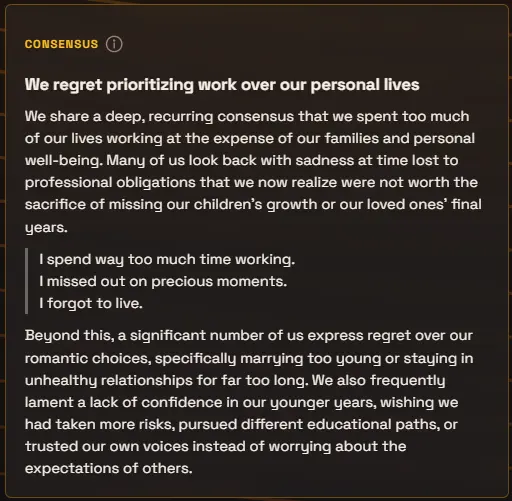
The report’s rule is that every claim must trace to an actual voice, and the cards quote the voices they lean on, trimmed for length but never reworded. This is what makes the report usable in front of the room that produced it. When a card says the group is torn, the group can see its own sentences sitting there as evidence, and when someone disputes a finding, the argument is with the quotes, not with a black box.
It also keeps the analysis falsifiable in the small ways that matter. A facilitator can glance from headline to quotes and judge whether the leap is fair before reading a card aloud. Cards that would have to stretch, say a Positive Deviance card in a room with no meaningful outlier, decline to stretch.
# Run it live and the room reads along on their phones
Deep dive is built to be a segment of the session, not homework afterward. Generate it while the room watches and the six cards land one by one on the projector. Every phone still sitting on the answer page grows a “Deep dive” link within a few seconds, no refresh, so the room opens the same report you are presenting and reads the evidence up close while you talk.
The stage view turns the report into slides, one lens per screen, stepped with the arrow keys, with the finding at headline size and the QR still up. Present from PowerPoint and the add-in inherits the same stepping. Each card carries a small info icon explaining what its lens looks for, which quietly teaches the room the instrument while you use it.
And because sessions get recorded, the analysis is retroactive. Any recorded period keeps its exact voices, so you can run a deep dive over last month’s retro today, or re-run this morning’s once the stragglers have answered.
# Three runs a day, Creator plan, and it never decides for you
Practical edges, stated plainly. Deep dive reads every voice six times over, so it is a deliberate act with a budget: three runs per voicer per day, with the counter shown under the button. It ships with the Creator plan.
And it does not facilitate. The report hands you findings with evidence; deciding which card the room needs to sit with, in what order, for how long, is the same judgment it has always been. Our position on that has not moved since we argued it at length: automate the reading, never the deciding.
# The six-lens debrief
A repeatable closing segment for any session that collected one open question’s worth of answers. Budget ten to fifteen minutes.
- Collect on one open question One question, the QR code, and enough time for the answers to stop arriving in a rush before you move to the debrief.
- Read the one voice first Give the room its blended answer before any analysis. It anchors what “taken together” sounds like, and every lens card that follows is read against it.
- Generate the deep dive in the open Press the button with the screen visible and let the cards land. Tell the room to reopen their answer link; the report appears on their phones as it forms.
- Step the lenses in order, but linger unevenly Walk Consensus through Tensions on the stage view. Read the headlines aloud, then spend your time where this room’s energy is; most sessions earn a long stop at either Minority Voice or Dissent.
- Land on Tensions and work forward Close by naming the trade-off the Tensions card surfaced and ask for next actions that respect both sides of it. Actions negotiated inside the tension are the ones that survive the week.
- Refresh only on purpose If late answers change the picture, one refresh replaces the report. You have three runs a day per voicer, which is enough for a session and its second wind.
# Frequently asked
How is a deep dive different from the blended one voice?
The one voice answers your question the way the room would, as one reply. A deep dive analyzes the room itself: six separate readings of the same answers, each answering a different question a facilitator would ask, each quoting its evidence. Read the one voice to hear the group; read the deep dive to understand it.
Can I customize the lenses?
No, and that is deliberate. The six lenses are a fixed instrument, so a card means the same thing in every session. For a custom reading, the response criteria field still does what it always did: type your own instruction and re-blend the one voice under it.
How many answers do I need before it is worth running?
There is no enforced minimum, and the page shows the current count so you can judge. Around a dozen voices the cards get real; with a handful, several lenses will honestly report thin signal rather than invent findings.
Does the room see the report or just the facilitator?
Both. The report has a phone-friendly page, and a link to it appears under the one voice on every participant’s answer screen the moment a report exists. You can also present it from the stage view or PowerPoint, one lens per screen.
What keeps the analysis honest?
Two rules. Every claim must come from an actual voice, and cards quote the verbatim voices they stand on, so the room can audit any finding against its own words. And a lens that finds nothing says so instead of stretching.
Which plan includes deep dive?
Deep dive ships with the Creator plan and up. The full comparison is on the pricing page.
# References
- Delbecq & Van de Ven, A Group Process Model for Problem Identification and Program Planning, Journal of Applied Behavioral Science (1971)
- Solomon Asch’s conformity experiments (1951–1956), summary and figures via Simply Psychology
- Irving L. Janis, Victims of Groupthink, Houghton Mifflin (1972)
- Positive Deviance Collaborative, The Vietnam Story: 25 Years Later (2018)
- Barry Johnson, Polarity Management: Identifying and Managing Unsolvable Problems, HRD Press (1992)