What 25 builders told us about community
We asked a room of builders what makes a community. Here’s what they said.
What you’ll learn
- Whether builders think AI has killed software development
- What they say actually builds a community
- How to run the same exercise with your group
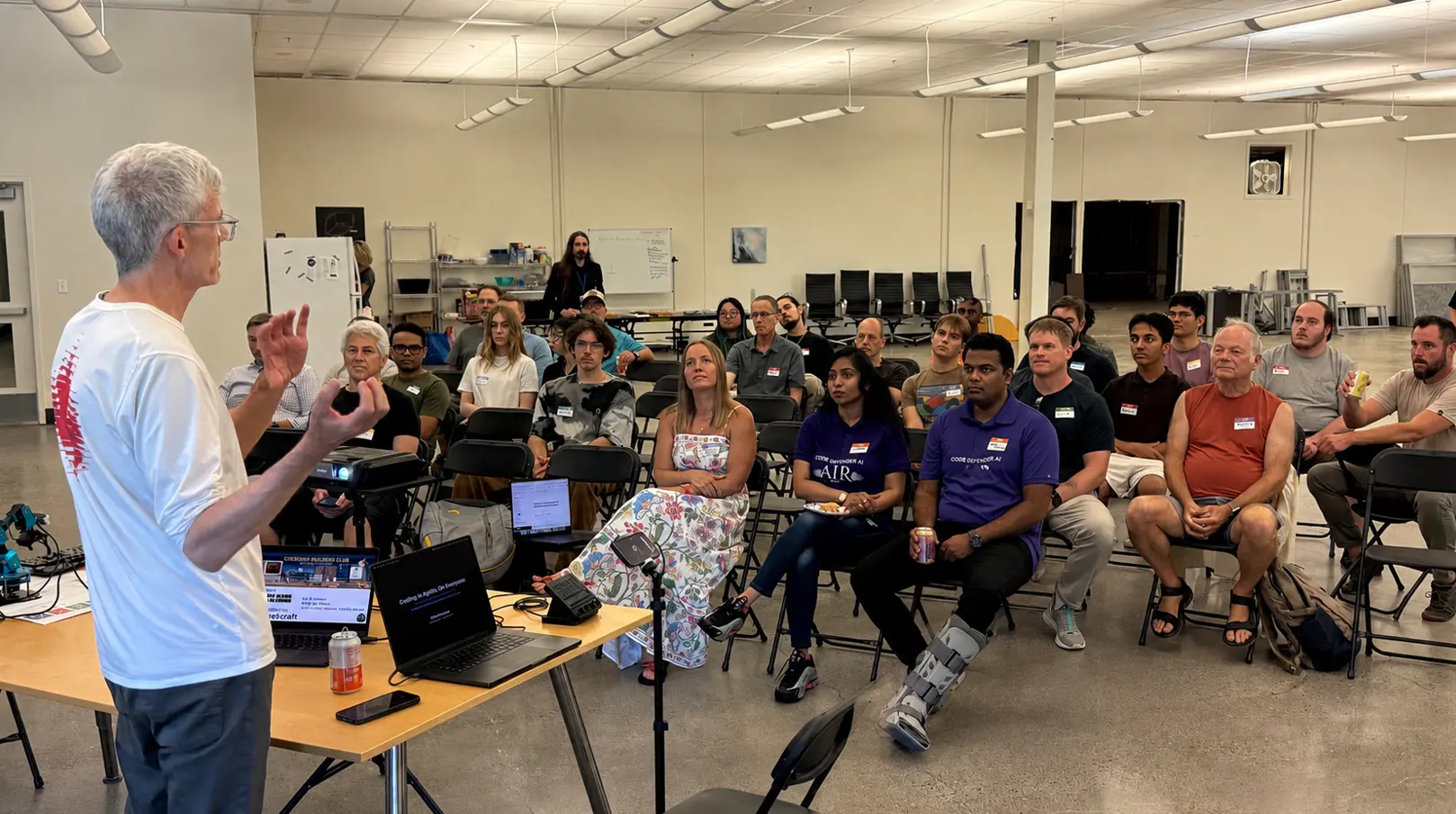
On a Tuesday evening in late August, about twenty-five builders sat on folding chairs in a big open room in east Vancouver, Washington. The occasion was the Cascadia Builders Club monthly demo night, hosted by Sam Keen in the space run by NorthBank Innovations. The club describes itself as show-and-tell for builders, “real demos, real people, no pitches,” and the evening ran exactly like that: a repurposed programmable keypad driving a multi-machine AI development setup, hardware from the Oregon AIR Challenge finalists, snacks, name tags, one projector.
We were on the demo list too, and our demo was mostly the audience’s. OneVoicer collects open answers from a crowd and blends them into a single voice, so instead of walking through screens we put a QR code on the projector and asked the room a question: is software development dead?
It is a fair thing to ask a room like that in 2026, when more than half of all web traffic is no longer human. A room you can be certain is entirely real was, honestly, part of the point of the evening. What the humans said is the rest of this post.
# “Is software development dead?” The room said no
The blended answer formed on the projector while people were still typing, and it was unpanicked. The room’s one voice called software development “evolving, not ending”: humans still audit the code, chase the strange bugs, and decide what is worth building, AI multiplies what one person can ship, and the job is drifting toward directing agents rather than typing every line. It reads like the considered consensus anywhere this year, which is to say it was true and a little dull.
The edges were better. Dave answered “No but people drive Model Ts too,” which we have read a dozen times now and still cannot decide is optimistic or devastating, and that ambiguity is why it was the best answer of the night. Someone else argued software engineering is on its way to being as widespread and unremarkable as literacy, less a profession than a baseline skill.
And Andrew went after the economics.
Tokens are expensive. Not enough power to power the god machine.
Andrew, answering “Is software development dead?”
# A room you can trust is getting rarer
If you build things, you already feel this, so we will keep it to the numbers and one old idea. Online, an audience you can trust and a way to be found are both degrading at once. A folding chair fifteen feet from a working demo has neither problem, and the people in the next chairs can find you again next month.
- Half the internet is not people
- Automated traffic reached 51% of all web traffic in 2024, the first time in a decade bots outnumbered humans (Imperva, 2025 Bad Bot Report).
- Most new content is machine-touched
- Of 900,000 newly published pages Ahrefs sampled in 2025, 74.2% contained AI-generated content. Only about a quarter were written entirely by a person. Whatever you launch, you launch into that flood.
- Local still compounds
- Michael Porter, 1998: “competitive advantages in a global economy lie increasingly in local things,” the knowledge, relationships, and motivation distant rivals cannot match. A region whose builders know each other moves faster than one that is merely co-located.
Porter, “Clusters and the New Economics of Competition,” Harvard Business Review ↗
# What: people connect over shared struggle
Then we moved to what we really wanted to know, and we used the classic three-question facilitation arc to get there: what (surface the experiences), so what (find the meaning), now what (decide what to do). Each round got its own question, and each blend stayed on the projector while the room answered the next one.
Round one, the what: “Thinking about communities or shared spaces you’ve been part of, what has helped you feel connected to the people there?”
Common goals, collaborative projects, and friendly attendees all showed up. The thread that kept recurring was less flattering and more interesting: failure. The connective tissue in this room is not the wins, it is the specific, nerdy ways things went wrong. The club’s no-pitches rule agrees: a pitch performs success, a demo shows a thing half-finished to people who might catch its problems.
What connected people, in their own words:
- Shared struggle
- “Being able to work on projects with common goals, sharing niche failures and successes.”
- Collaboration
- “Working in connection and collaboration with other people helps breed creativity.” (Dave)
- Common ground
- “Friendly attendees, shared goals or backgrounds.” (Michael)
- A collective cause
- Welcoming environments that invite people to contribute to something bigger than their own project.
If someone has experienced hardship similar to mine I feel camaraderie.
One of the room’s voices, on what creates connection
# So what: “enough structure to allow for free play”
Round two, the so what, asked the room what matters most in turning a shared space into a real community. One anonymous phone typed the seven words in the heading, a better theory of community events than most books on the subject manage.
Here is what that phrase means in practice: give the gathering a spine, and leave gaps in it. The demo night is the pattern exactly. A fixed hour of demos means nobody wonders what the evening is for, and the unscheduled hour on either side is where strangers actually become friends. The structure solves the cold start; the free play does the connecting. Table prompts, founder roundtables, and hackathons all work the same way.
The rest of what the room put at the center, in its own words:
- Vulnerability
- “Hearing shared struggles is a good way to feel honest with one another.”
- Honest commitment
- “Honest commitment to working together.” “Everyone has a stake in it. It is warm and friendly and collaborative.”
- A clear way in for new people
- “Real collaborations. Where people are familiar with others in the community, and the process for getting new people involved is clear.”
- Coffee
- “The best coffee is essential. The juice of life!!” We pass that along unedited. Sometimes community is coffee.
# Now what: a to-do list that ended with demo nights
Round three, the now what, was the practical one: “Based on that, what’s one thing a coworking or incubator space could do next month to help people build stronger connections?” The next-month constraint worked; the answers came back concrete enough to put on a calendar, and NorthBank Innovations, the nonprofit incubator that hosts the club, walked away with a backlog its own members wrote.
Watch the last item as you read them. Asked how to build community, a person at a demo night, phone in hand, answered: hold demo events. An endorsement of the format, collected live from inside the format.
- Give people a moment to tell their story
- “Could allow others to latch onto experiences that they personally empathize with.” Five minutes, one member, any recurring event.
- Test each other’s products
- “Shared product testing and shared knowledge of wins and failures,” which is the struggle thread from question one arriving as a program idea.
- Run founder small groups
- “More founder small group sessions to help them be accountable.”
- Hold demo events
- “Have an event where startups they are working with demo their product.”
NorthBank Innovations, the nonprofit incubator and coworking space that hosted the night ↗
# How we ran it, for anyone who wants to copy it
The mechanics were light. The AI question ran as a standalone voicer. The three community questions ran as a group, opened one at a time so each round could react to the one before. Respondents scan a QR code and type; there is no app and no account. Answers blend into one voice on the projector within seconds and re-blend as more arrive, and every raw answer stays browsable in a list, which is where Dave’s Model T turned up.
The one deliberate move worth stealing: the first blend of any room is polite consensus, because that is what blending does. Ask for the outliers too. The interesting material in this post, the god machine, the Model T, the coffee, all came from going looking for the fringe instead of settling for the summary.
The same three-question arc, run with 50 strangers in under five minutes →
# Ask your room
This works at any recurring gathering with a projector: a meetup, a coworking open house, a user group. Plan for about ten minutes inside the program, plus whatever conversation it starts.
- Open with an icebreaker that has stakes Ask something the room genuinely disagrees about, aimed at who they are. “Is software development dead?” worked because it was pointed straight at the people in the chairs. Put the QR code up and let the blend form while people settle.
- Run what, so what, now what about the community itself Three questions in a group, opened one at a time: what has helped you feel connected, what matters most in turning this space into a community, and what should this space do next month. Show each blend before opening the next question so the rounds build on each other.
- Read the consensus, then ask for the fringe Read the one voice aloud, then pull out the answers only one or two people gave and read those too. That is where the best material of our night came from.
- Hand the now-what list to whoever runs the space The third round’s answers are a to-do list written by the members themselves. Send it to the organizer the same night, while the goodwill is warm.
# Frequently asked
Doesn’t asking people to type on their phones break the energy of an in-person event?
The typing lasts under a minute per question, and it buys the room something worth the pause: the next stretch of conversation is about what everyone said, instead of whatever the first hand raised. The blend goes on the projector, people see their own thinking reflected back, and in our experience the talk that follows is livelier for it.
How many people do you need for this to work?
Our room was about twenty-five, which gave the blend plenty to work with, including a usable fringe. We have run the same three-question arc with fifty strangers online. With fewer than ten or so answers a blend still reads fine, but at that size you might simply talk instead.
What should a space do with the now-what answers?
Treat them as a backlog, not a survey result. Pick one item, run it the following month, and say where the idea came from. Then ask the three questions again a quarter later; the answers change as the community does.