How to track the voice of the community you moderate
Hear from your whole community, not just the loudest threads.
What you’ll learn
- Why comments show only a small, loud slice
- How to ask a question quiet members will answer
- How to track what your community thinks over time
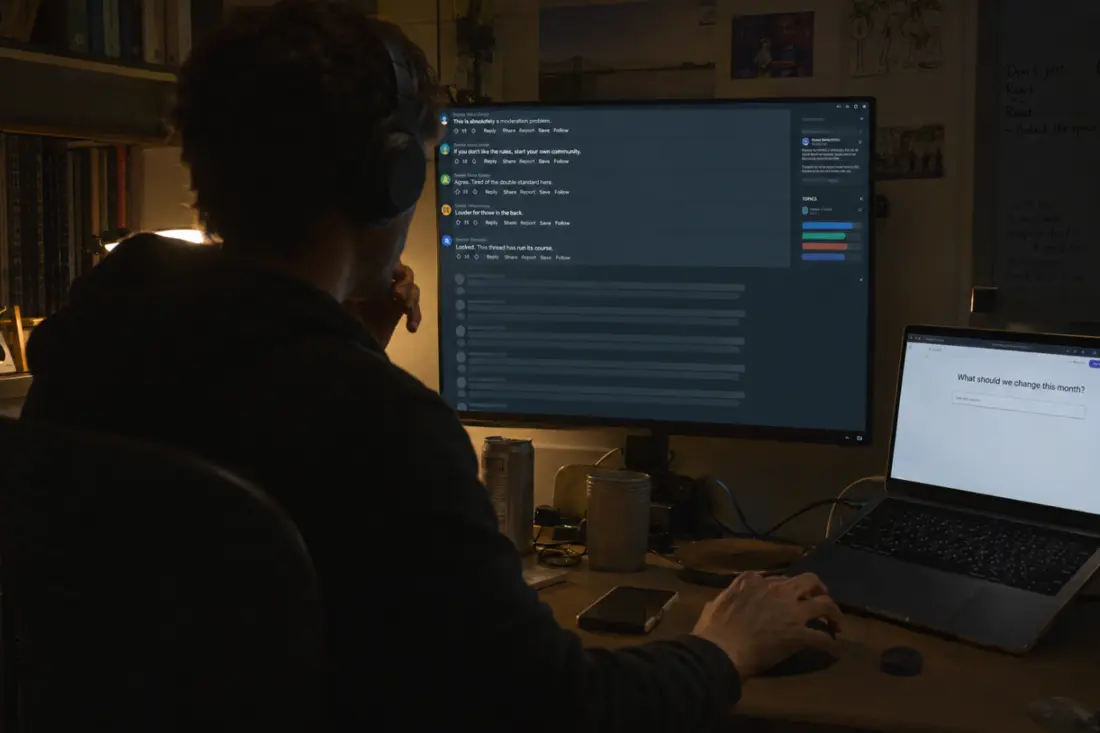
Every moderator knows the moment. You post a rule change, a format tweak, a new channel, and forty furious comments arrive within the hour. Is that the community speaking, or is it forty people out of eighty thousand? You genuinely cannot tell, and yet the decision gets made on that signal, because it is the only signal you have.
Moderation is real work. A 2022 study presented at ICWSM measured Reddit moderators collectively putting in at least 466 hours of moderation work per day, unpaid labor the authors valued at $3.4 million a year. But the hardest part of the job is not the work you can see piling up in the queue. It is the question with no queue at all: what does this community actually want?
This article is about answering that question simply: why the thread is a distorted instrument, what tools moderators reach for today, the craft of asking a question your silent majority will actually answer, and how to track the answer over time instead of sampling it once.
# The comment section is not the community
Participation in online communities is so lopsided that the pattern has had a name for twenty years. Jakob Nielsen of Nielsen Norman Group called it the 90-9-1 rule in 2006, and it has held up across every platform since:
- 90% lurk
- They read, vote occasionally, and never post. They are your members, your subscribers, your regulars, and they are invisible in every thread.
- 9% contribute occasionally
- A comment when something really moves them, then months of silence.
- 1% produce almost everything
- The regulars you know by name. Nielsen found the skew gets more extreme as communities grow; on Wikipedia, 99.8% of users never edit at all.
The first step to dealing with participation inequality is to recognize that it will always be with us.
Jakob Nielsen, Nielsen Norman Group (2006)
# Your quietest members are not disengaged
It is tempting to read silence as indifference, and the research says that reading is wrong. When Preece, Nonnecke, and Andrews surveyed members across 375 online communities in 2004, the lurkers’ top reasons for never posting had little to do with not caring: just reading was enough for their needs, they were still getting a feel for the group, and, striking in hindsight, many felt they were being helpful by not adding noise. The same research team’s earlier study found lurking rates ranged from about 46% in health-support communities to 82% in software-support ones.
In other words, the silent majority has opinions. What it does not have is any appetite for voicing them in a fast, public, identity-attached thread where the regulars are already arguing. That constraint should shape whichever tool you pick next: if answering requires posting publicly under a known username, you have filtered your feedback back down to the 1% you already hear from.
# The moderator’s toolbox today
Moderators are not short on instruments; each one just measures a different, narrow thing. Laid side by side, the gap they share is visible:
| Tool | Good for | The catch |
|---|---|---|
| Platform polls (Reddit, Discord) | Fast verdicts between options you predefined | You have to know the possible answers in advance; open questions do not fit |
| Pinned feedback thread | Depth, debate, and specifics | Written by the same 1%, in public, under usernames |
| Emoji reactions and upvotes | A one-tap temperature read | Measures agreement among whoever votes; produces no ideas |
| Annual survey (Google Forms) | Thorough, structured detail | A once-a-year snapshot, weeks of analysis, stale the day it ships |
| Standing open question | The quiet majority, in their own words, continuously | Someone has to read hundreds of free-text answers |
# Asking a question the silent majority will answer
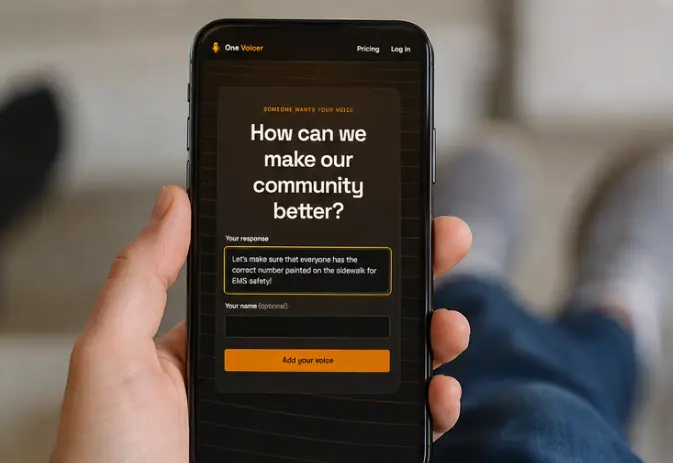
The last row of that table is the interesting one, and it only works if the asking is done with some craft. Four rules cover most of it:
- One question at a time
- Not a survey. A single standing question like “what should we change this month?” or “what kind of posts do you want more of?” A form with ten fields is a task; one box is a thought.
- Answerable in one sentence from a phone
- Phrase it so a member can answer between two other things they are doing. If the honest answer needs three paragraphs, the lurkers will not write it.
- Anonymous and account-free
- This is the lesson of the lurker research. The people you have never heard from will not create an account or attach their username to an opinion. A bare link they can tap and type into is the whole trick.
- Put the link where lurkers read
- Sidebar and community info, a pinned post, the welcome message, an automod sticky comment, a Discord channel topic. Lurkers see all of it; they just never reply to it. A link asks less than a reply does.
# Track the voice, don’t poll it
A poll is a photograph; a community is weather. Opinion drifts as members join and leave, as a game updates, as last month’s controversy fades. Sampling it once tells you where the room stood the week you asked. Tracking means the question stays open and the answer stays current.
This is the problem OneVoicer was built around. Your standing question lives at one link; every answer is a “voice,” and the AI blends all of them into a single paragraph that speaks for the room, rewritten as new answers arrive. Reading one paragraph is a minute of mod work. Reading four hundred raw replies is a weekend, which is why open feedback threads rot. Every individual voice stays browsable underneath, and off-topic ones can be removed from the blend.
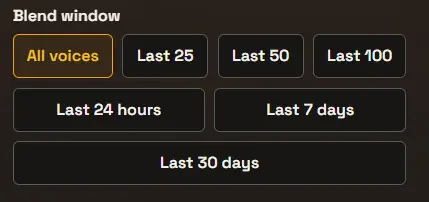
For a question you leave open indefinitely, a trailing blend window keeps the voice honest: blend only the last 100 voices, or only the last 7 days, so the paragraph reflects what the community thinks now rather than an average diluted by answers from three months ago.
# Turn the question into a series
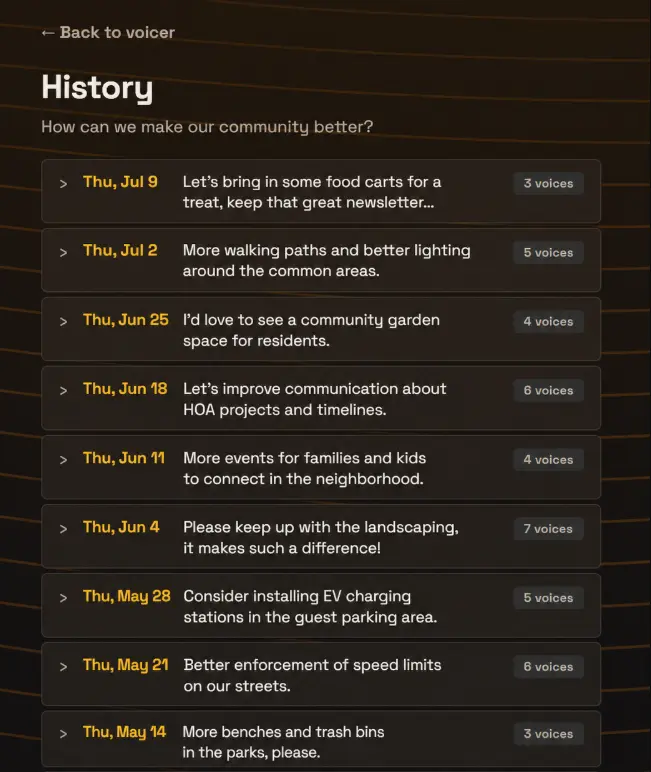
The other half of tracking is memory. With record and reset on a weekly schedule, every 7 days the current blend is saved to the question’s history and the voices reset for a fresh week. Members who answered last week get a fresh voice this week, so answering becomes a habit rather than a one-time event, and the history becomes something no feedback thread ever produced: a dated, week-by-week record of what the community wanted, readable top to bottom in minutes.
That record changes mod-team conversations. “I feel like people are tired of the meme flood” becomes “it has been the top theme for three straight weeks.” A new mod can read two months of digests and know the room. And when you do make the controversial call, you can point at the record, because the forty furious comments now have a counterweight.
One habit completes the loop: report back. A short monthly “you said, we changed” post, in the community, where everyone can see it. The research on lurkers says many stay quiet because they doubt their post adds anything; visible proof that answers get read and acted on is the strongest counterargument you can make.
A community that watches its answers change things answers again. Close the loop in public.
# A monthly voice-of-the-community routine
One standing question and about twenty minutes of mod time a month. It works the same for a 2,000-member Discord and a million-subscriber subreddit.
- Pick one standing question Something every member can answer in a sentence and that you genuinely want to act on: “what should we change this month?” is the workhorse.
- Put the link where lurkers read Sidebar or community info, a pinned post, the welcome message, an automod comment or a Discord channel topic. No account, no sign-in, one box.
- Set it to record and reset weekly Each week the blend is saved to history and the voices reset, so every member gets a fresh say and the record builds itself.
- Read the blend each week One paragraph that speaks for the room, with the individual voices underneath when you want the specifics. Minutes, not hours.
- Post a monthly “you said, we changed” recap Quote the themes, say what you did about them, and say what you decided not to do and why. This is what makes next month’s answers arrive.
- Rotate the question when it goes quiet A standing question earns its place for a season. When answers thin out or repeat, retire it to history and ask the next one.
# Frequently asked
Won’t an anonymous question box just get trolled?
Less than you would expect, and the blend is naturally resistant: one troll is one voice among hundreds, not a top comment with upvotes to farm. Off-topic answers can be removed from the blend, and if a question starts drawing organized mischief you can require sign-in, which limits it to one voice per account without exposing anyone’s answer publicly.
How is this different from a Reddit or Discord poll?
A poll needs you to know the possible answers in advance, so it can only confirm or rank ideas you already had. An open-ended standing question surfaces the things you did not think to ask about, which for a moderator is usually the valuable part. The two work well together: let the open question find the options, then run a poll to pick between them.
How many answers count as representative?
Treat it as signal, not science; it is not a random sample and does not need to be. Thirty answers from members who have never once posted is a category of information you have literally never had. The trend matters more than any absolute number: the same theme rising for three weeks is meaningful at almost any volume.
My community lives on more than one platform. Does this still work?
Yes, and that is a quiet advantage of using a plain link instead of a platform feature. The same question link goes in the subreddit sidebar, the Discord channel topic, and the Facebook group description, and every answer lands in the same blend, so you read one voice for the whole community rather than three partial ones.
# References
- Jakob Nielsen, “The 90-9-1 Rule for Participation Inequality in Social Media and Online Communities,” Nielsen Norman Group (2006)
- Li, Chancellor and Hecht, “Measuring the Monetary Value of Online Volunteer Work,” ICWSM (2022)
- Preece, Nonnecke and Andrews, “The top five reasons for lurking: improving community experiences for everyone,” Computers in Human Behavior (2004)
- Nonnecke and Preece, “Lurker Demographics: Counting the Silent,” CHI (2000)