How to collect honest feedback from your HOA
Hear from every household, not just the angriest five.
What you’ll learn
- Why most homeowners never speak up
- How to ask the whole neighborhood in 30 seconds
- How to bring what they said to the board
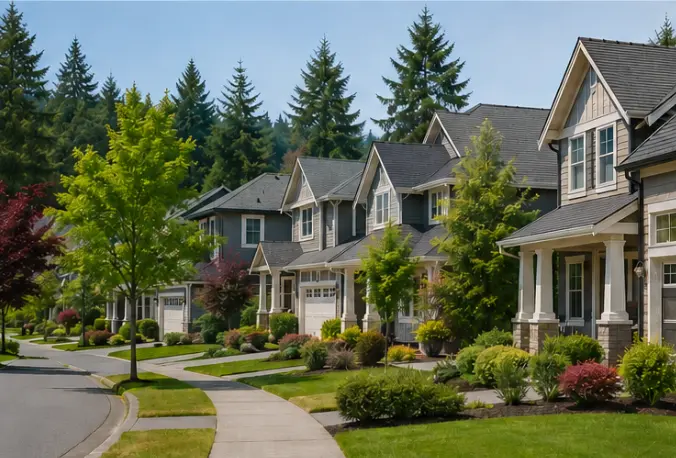
Every HOA board builds its picture of the neighborhood from the same few people: the homeowner upset enough to attend the meeting, the regular who emails weekly, the neighbor who catches a board member at the mailbox. They are real voices and they deserve answers, but they are a terrible sample. The family that loves the new landscaping, the retiree quietly worried about speeding on the through street, the new owner with a good idea and no interest in a Tuesday-night meeting, none of them said a word this month. A board that only hears the upset few ends up governing for them, and is then surprised at the annual meeting by a neighborhood it never actually heard. Hearing everyone takes one question, one QR code, and thirty seconds of each homeowner’s week.
# The only feedback channel is the one nobody uses
Community associations are enormous, and enormously quiet. The Foundation for Community Association Research counts 373,000 associations in the U.S. with 78.1 million residents in its 2025 Fact Book, and most of them are run by volunteer boards with the same two listening tools: a meeting and, maybe, an annual survey. Every board knows how those go. The annual meeting scrapes for quorum and gets adjourned to a second attempt, the survey comes back from a fraction of households, and the inbox fills only when something has already gone wrong.
So the board’s sample becomes whoever shows up, and whoever shows up is whoever is upset. That is not a character flaw in the neighborhood; it is what the channel selects for. Attending a meeting costs an evening, and people spend an evening on a grievance, not on “things are mostly fine, but the guest parking could use EV charging.” The suggestion-shaped voices, the ones a board could actually plan around, never make it into the room.
# Why homeowners stay silent
An HOA is not an audience, it is a set of neighbors. Raising your hand at a meeting means disagreeing, on the record, with someone you will see at the mailbox for the next decade. Emailing the board about a neighbor’s trailer feels like the first move in a feud. Most homeowners run that math instantly and choose silence, and the ones who break the silence are, by selection, the ones angry enough not to care. Anonymity is not a nice-to-have in this setting. It is the difference between hearing the neighborhood and hearing its five loudest members.
Here is the part boards consistently misread: the quiet majority is not seething. In the Foundation for Community Association Research’s 2026 Homeowner Satisfaction Survey, 86% of residents rate their community association experience as positive or neutral, and 82% say their board serves the community’s best interests. The neighborhood is mostly content and full of small, practical wishes. If your only channel is the one that takes courage to use, you will hear the furious few and mistake them for the whole street.
# Put one question in front of the whole neighborhood
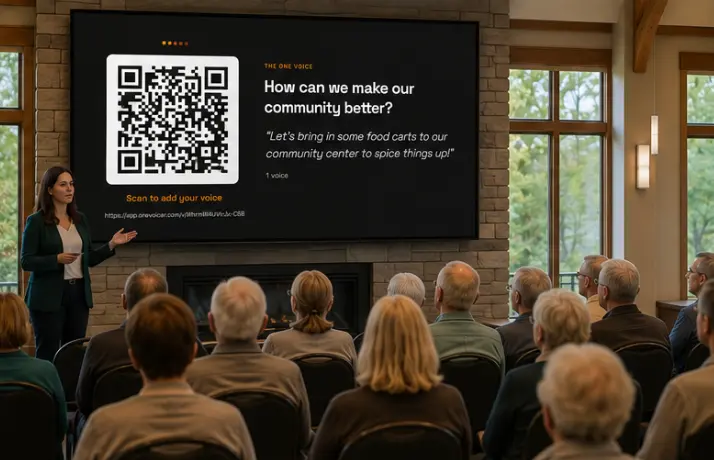
The fix is one standing, open question: “how can we make our community better?” Put its QR code everywhere homeowners already look, in the newsletter, on the clubhouse bulletin board, in the community Facebook group, on the screen at the annual meeting and the summer social. One question, asked everywhere, all the time. No twenty-field survey, no login, no meeting.
As answers arrive they are blended into one short summary, a single paragraph that reads like the neighborhood thinking out loud. On a screen at a community event that summary forms in real time, which does something a suggestion box never did: it shows residents their neighbors’ answers converging with their own, and it announces that this is a community where what you think gets asked for.
# Thirty seconds from the couch, no app
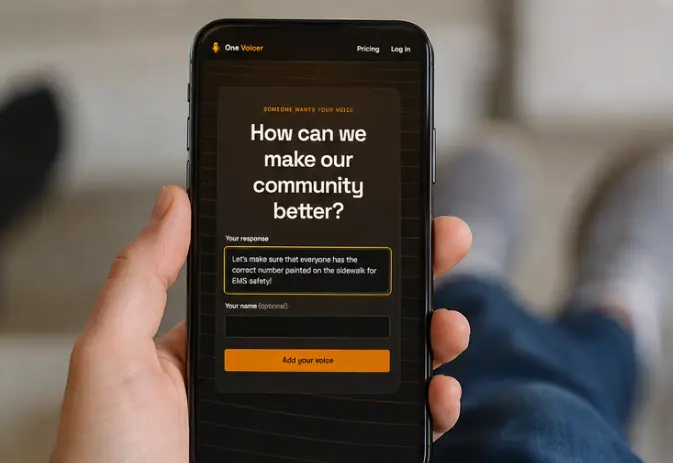
From the homeowner’s side the whole exchange fits between two sips of coffee. Scan the code in the newsletter and the question opens in the phone browser: nothing to install, no account, and a name field that is genuinely optional. Type a sentence, tap once, done.
And the sentences are gold. “Let’s make sure everyone has the correct number painted on the sidewalk for EMS safety” is a real suggestion a board can act on next week, and it is exactly the kind of voice the meeting never hears, because the person who thinks of it is not angry about anything. They were never going to spend a Tuesday evening on it. They will absolutely spend thirty seconds on it.
# Set it to weekly, and the question becomes a neighborhood digest
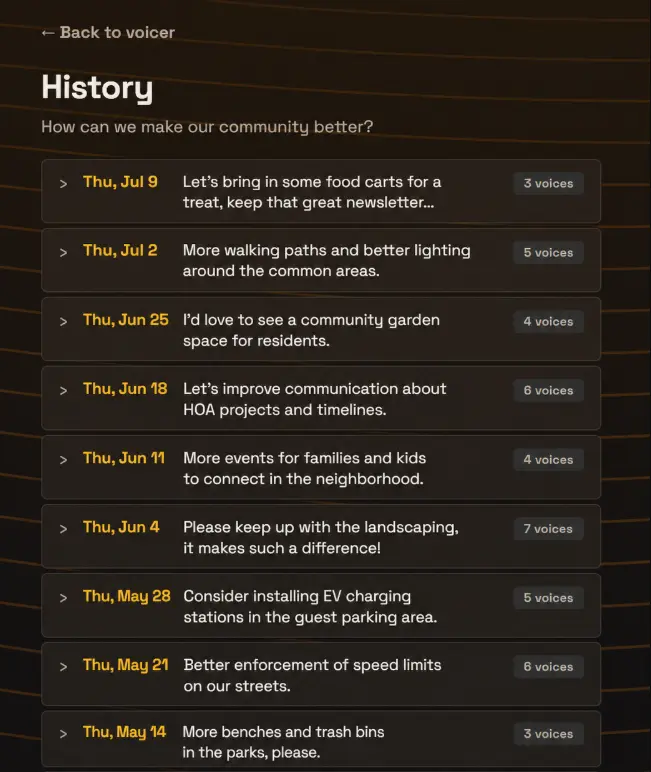
This is where the standing question turns into something a board can run on. Turn on record and reset and set it to weekly: every week, on the day you choose, the current blend is saved to the question’s history and the voices reset. Each history entry is a one-paragraph digest of the neighborhood’s week, readable in less time than a single complaint email.
The weekly reset also gives every homeowner a fresh voice each week. Someone who asked for better lighting in June can raise speeding in July, so answering becomes a habit instead of a one-time event, and this week’s concern never has to compete with April’s. Nothing is deleted along the way: past weeks stay in the report, and a slow week still gets its row, so the record stays honest.
Scroll a season of it and you are reading the neighborhood’s mind in order: more walking paths and better lighting, a community garden, clearer communication about project timelines, EV charging in the guest parking, speed limits on the through streets. No meeting produced that list. Ten quiet weeks of a QR code did.
# Walk into the board meeting with the digest
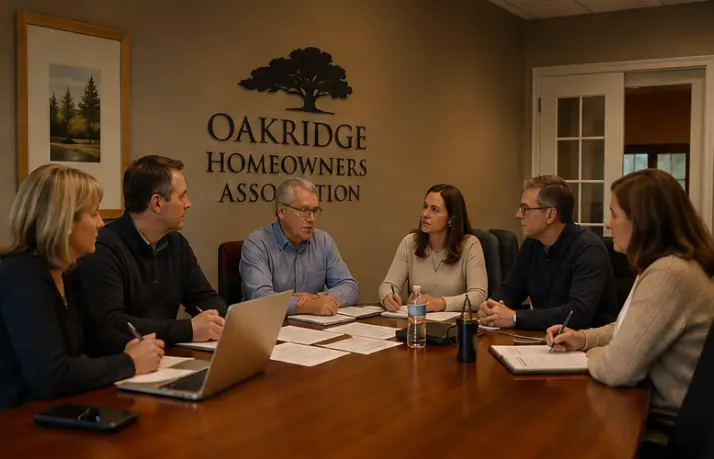
Now the monthly board meeting starts differently. Instead of opening with the loudest email of the month, the board opens by reading the last few weekly digests aloud, two minutes that put the whole neighborhood in the room before any decision gets made. The agenda stops being a reaction to whoever pushed hardest and becomes a reply to what the community actually said.
The history earns its keep beyond the monthly meeting, too. Budget season starts from a dated record of what residents asked for all year. The annual meeting opens with trends instead of anecdotes. And a new board member can read six months of digests in ten minutes and know the neighborhood better than a year of meetings would have taught them.
# Close the loop in the newsletter
The loop closes with one line in the next newsletter: “you asked for better lighting along the walking paths; the board collected two bids this week.” That sentence costs nothing and changes everything, because it proves that answering the question does something. Residents who see their input show up in a decision answer again, and the standing question compounds instead of fading.
It is also the board’s receipt. Every association has a “the board never listens” chorus, and the honest answer used to require a defensive paragraph. Now it is a link to the history: here is what the neighborhood said, week by week, and here is what we did. This is the part OneVoicer carries for you. It reads every voice and blends them into one clear answer, so closing the loop takes a sentence in the newsletter, not a volunteer’s weekend with a spreadsheet.
# A neighborhood listening habit, one evening to set up
One standing question, a weekly digest, and a line in the newsletter. After the first month it runs itself.
- Create the standing question Ask “how can we make our community better?” and turn on record and reset, set to weekly. Pick the rollover that lands the fresh digest the morning of your board-prep day.
- Put the QR code where homeowners already look The newsletter, the clubhouse bulletin board, the community Facebook group, and the screen at every community event. No app, no account, thirty seconds.
- Open every board meeting with the digest Read the recent weekly blends aloud before setting the agenda. Two minutes, and the whole neighborhood is in the room before the first decision.
- Answer in the next newsletter “You said, we did,” one line per item. Closing the loop visibly is what turns answering into a neighborhood habit, and it is the receipt when anyone says the board does not listen.
# Frequently asked
Do homeowners need an app or an account?
No. They scan a QR code or tap a link and answer in the phone browser in about thirty seconds. There is nothing to install and no sign-up, and the name field is optional.
Are the answers anonymous?
By default, yes, and for neighbor-to-neighbor honesty that is the right setting: people say more when their name is not attached and the board member is not standing in front of them. If you ever need one verified answer per household, for example an informal poll you plan to quote, you can require sign-in on that question instead.
Can someone answer every week?
Yes. With record and reset set to weekly, each week is a fresh start: a homeowner who answered last week can add a new voice this week. Within a single week they still get one voice.
Is this a formal vote?
No. Elections, budget ratifications, and covenant amendments are governed by your bylaws and state law, and this does not replace any of them. It is the sentiment layer underneath: a running read of what the community wants, so the formal votes stop being surprises.
What does it cost for a typical association?
The free Starter plan runs three live questions with up to 25 voices each, enough to put the standing question in one newsletter and see what comes back. The weekly digest uses record and reset, which is a Creator plan feature, so an association running the full loop fits the Creator plan.
What about rants and neighbor disputes?
A few will arrive, and the blend handles them better than a meeting does. The summary reflects the whole set of answers, so one rant washes out once ordinary suggestions surround it, and you can always open the individual voices and remove anything that crosses a line.
# References
- Foundation for Community Association Research, “Community Association Fact Book: Statistical Review” (2025) · 373,000 community associations in the U.S. with 78.1 million residents
- Foundation for Community Association Research, “Homeowner Satisfaction Survey” (2026) · 86% of residents rate their community association experience as positive or neutral; 82% say their board serves the community’s best interests