How to stay customer-obsessed as your business grows
The better you know your product, the less you see it like a customer. Here’s how to stay close.
What you’ll learn
- Why expertise pulls you away from your customers
- Why another survey won’t close the gap
- A simple listening habit you’ll actually keep

Every business starts out customer-obsessed by accident. In the early days you are basically a customer yourself: you feel the same frustration that made you start, you read every reply, you remember the name of the person who complained on a Tuesday. You are close because you have not had time to be anything else.
Then it works, and growth quietly takes that away. You learn your own product inside out. You learn the pricing, the edge cases, the reasons things are the way they are. You become the world expert on your business, which is exactly the problem, because the person who drives your next stage of growth is not an expert. They are a newcomer who has never heard of you, and the better you know your own thing, the harder it is to remember what theirs is like. Staying customer-obsessed is not about caring more. It is about fighting the drift that success creates.
# The closer you get to your business, the further you drift from your customer
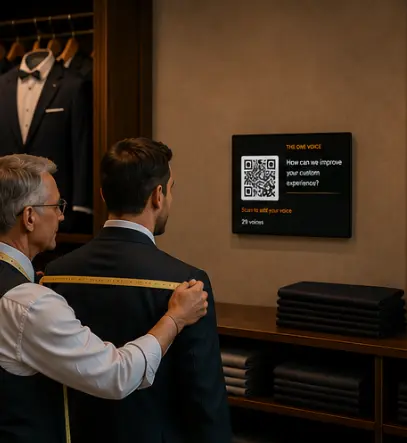
Expertise feels like getting closer to your customer. It is usually the opposite. Every month you run the business, you accumulate context a first-timer will never have: why the onboarding asks for that field, what the third tab does, which plan is “obviously” the right one. That context is real and useful, and it slowly rewrites the map in your head so it no longer matches the map in theirs.
The more complex the business gets, the wider the gap. You start answering the question you would ask, pricing for the buyer you have become, writing copy that makes perfect sense to someone who already knows the answer. None of it feels like drift from the inside. It feels like competence. That is what makes it dangerous: the very thing you are rewarded for, knowing your business cold, is what disqualifies you from seeing it like the customer who matters most.
# You cannot un-know what you know
There is a name for why this is so hard to beat with willpower. In 1990, a Stanford graduate student named Elizabeth Newton ran an experiment for her PhD that has been retold ever since. People were split into “tappers” and “listeners.” Each tapper picked a well-known song and tapped its rhythm on a table; each listener tried to name the tune from the taps alone. Before they started, the tappers were asked to predict how often the listeners would get it. They guessed about half the time.
Listeners identified the song 2.5% of the time: three out of 120. Chip and Dan Heath open their book “Made to Stick” (2007) with this study and give the effect its name, the curse of knowledge. The tappers could hear the full song in their heads, so the taps sounded obvious to them. They could not un-hear it, and so they could not imagine the silence the listener was sitting in. That is you, with your own business. You cannot switch off everything you know about it, which means you cannot reliably feel what a newcomer feels. The only way back into that head is to ask the person who is actually in it.
# Everyone thinks they are customer-obsessed. Customers disagree
If the curse of knowledge is invisible from the inside, you would expect companies to be confident they are doing fine. They are. When Bain & Company surveyed 362 companies for its 2005 study “Closing the Delivery Gap,” 80% believed they delivered a superior experience to their customers. Then Bain asked those companies’ customers. Only 8% agreed.
That gap, between 80% and 8%, is the drift made visible across an entire economy. It is not that those companies were careless or unusually arrogant. It is that they were measuring themselves with the expert’s map, the one that says “we know this is good because we built it,” and never checked it against the customer’s. The study is two decades old now, and the gap is the kind of thing that does not date, because the cause has not changed. The people running a business will almost always rate it higher than the people using it, unless they have a steady way to hear otherwise.
# Your customer is a moving target

Even if you closed the gap perfectly today, it would reopen, because the customer keeps moving. What people expect, what worries them, and what they are comparing you against all shift underneath you, often faster than your product does. The understanding you earned two years ago is quietly expiring right now.
The bar keeps rising in particular. Salesforce’s “State of the Connected Customer” (5th edition, 2022) found that 88% of customers say the experience a company provides is as important as its products or services, up from 80% in 2020, and that 73% expect companies to understand their unique needs and expectations. “Good enough” is a moving line, and it moves up. This is why understanding your customer is not a project you finish. The intentions and concerns you are trying to track morph over time, so the listening has to be continuous or it goes stale.
# Why the gap is worth the trouble of closing
This is not just a matter of being nicer to customers. Staying close to them tracks with how the business actually does. Frederick Reichheld and W. Earl Sasser argued in Harvard Business Review in 1990 that even a small improvement in customer retention has an outsized effect on profit, a finding Reichheld later popularized in “The Loyalty Effect” (1996): hold on to a few percent more of your customers and profit can climb dramatically, because the customers you keep are the cheapest and most valuable ones you have.
The same direction shows up in newer numbers. Forrester, in its 2024 US Customer Experience Index, reported that the organizations it classifies as customer-obsessed saw faster revenue growth, faster profit growth, and better customer retention than everyone else. Forrester’s figures are self-reported and only a small share of companies clear its bar, so treat them as a signal rather than a guarantee. The signal is consistent, though, across decades and methods: the businesses that stay close to the customer tend to be the ones that grow. The drift is not just a blind spot. It is expensive.
# The fix is not a survey. It is a habit
The instinct, once you accept the gap, is to launch a Big Customer Survey. Forty questions, a quarter to design it, a slide deck at the end, and then back to work. The trouble is that it treats understanding your customer as a one-time excavation, when the whole problem is that the target keeps moving. You close the gap for a month and then drift right back open, because you went back to being the expert the day the survey closed.
What actually beats the drift is small and boring: a steady habit of listening that you never stop doing. One open question your customers can answer in seconds, and a short, regular rhythm of reading what comes back. The point is not to gather more data. It is to keep one channel open to the newcomer’s head so it never fully closes again. A habit you keep beats a study you finish, every time.
# Two reviews, neither of them long
A listening habit only works if it is light enough to survive a busy week, so keep it to two reviews, both short. The weekly one is a read of the room: fifteen minutes with the answers that came in since last time, asking one question of your own, “what changed?” You are not analyzing. You are staying current, catching the new complaint or the new phrase before it becomes a trend you missed.
The monthly one is a step back. Instead of this week’s answers, you look at how the answer itself has moved over the last several weeks. The weekly read keeps you current; the monthly read shows you the drift, the slow shift in what people are asking for that no single week makes obvious. That is the one that protects you from waking up a year later realizing the market moved and you did not.
- Weekly, ~15 minutes
- Read the most recent answers. Ask “what changed since last week?” Flag anything new. Do not act yet, just notice.
- Monthly, ~30 minutes
- Ignore the week. Look at how the overall answer has shifted over the month. Name the trend, then pick one thing to change.
# It takes practice, not effort
Here is the part nobody warns you about: doing this well is a skill, and at first you will be bad at it. The first few weeks the answers will feel thin, or obvious, or contradictory, and you will be tempted to conclude that customers do not know what they want and quietly stop. That is the curse of knowledge fighting back. Reading what customers actually say, rather than what you expected them to say, takes reps.
The good news is that it compounds. After a couple of months you start to hear the difference between noise and a real signal, you write sharper questions, and you notice shifts earlier. None of it is hard work in the sense of being heavy. It is hard in the sense of being easy to skip, which is why the only thing that matters is keeping the habit small enough that you never do.
# A standing question anyone can answer in seconds
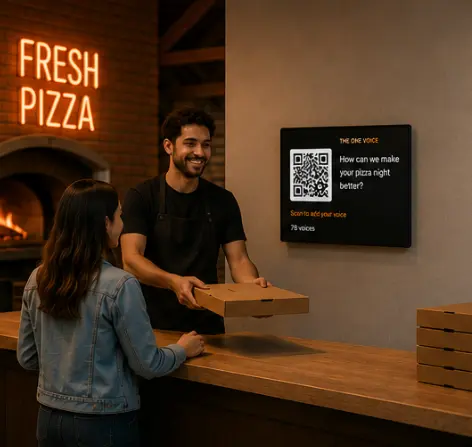
This is the loop OneVoicer was built to run, so it is worth being concrete about how the habit looks in practice. You write one open question, the kind you would put to a customer if you had them for ten seconds, and you keep it standing: “what is one thing we could do better?” You share it as a link or a QR code, and anyone can answer from their phone browser with no app and no account in the way. That last part matters more than it sounds, because every sign-in wall you add filters your answers down to the few most motivated people and silences the casual newcomer whose head you were trying to get into.
Instead of a spreadsheet of raw replies you have to wade through, OneVoicer blends every answer into a single readable “one voice,” the gist of what the whole crowd is saying, updated as new answers arrive. That is what makes the weekly fifteen minutes actually fifteen minutes. The free Starter plan runs this loop; if you want one verified answer per customer rather than open responses, requiring sign-in is a Creator plan option.
# Pick the window that fits where you are
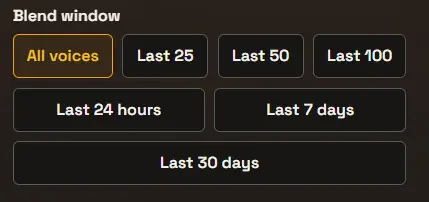
A blend window decides which answers feed the one voice, and it is a single choice, not several at once. You pick one: every answer, the last so-many, or a trailing stretch of time. So the question is not how to watch every window at the same time, it is which interval fits where your business is right now.
When you are new and things change week to week, you want to see movement, not just today’s snapshot. Turn on daily record and reset (a Creator plan feature): it records the one voice each day, starts the next day fresh, and builds a history you can scroll. That history is the drift made visible in your own data, the slow shift in your customers’ answer that the expert in you would otherwise never notice.
As the business settles, a single trailing window is usually enough. Blend the last 24 hours or the last 7 days so the one voice always reflects where your customers are now (trailing windows are a Creator plan feature; the free Starter plan blends every answer together). And when one question cannot hold everything you want to watch, run a few, a voicer per topic, each with the window that suits it, and read them in the ways that fit.
# A customer-listening habit you will actually keep
You do not need a research team or a forty-question survey. You need one good question, an effortless way to answer it, and two short reviews you can keep up. Here is the whole habit.
- Keep one standing question Pick a single open question about your customers’ experience, not your product. “What is one thing we could do better?” works. Leave it open and ask the same crowd over and over rather than reinventing it each time.
- Make answering nearly free Share it as a link or QR code that opens in a phone browser with no app and no sign-up. Every step you remove widens the range of customers you hear from, especially the casual newcomer you most need.
- Read it weekly, for fifteen minutes Once a week, read the recent answers and ask only “what changed?” You are staying current and catching new themes early, not running an analysis.
- Step back monthly Once a month, ignore the week and look at how the overall answer has shifted. Name the trend you see. This is where you catch the drift before it becomes a surprise.
- Change one thing, then say so Act on a single thing each month and tell customers you did. It proves the question is real, which keeps people answering, which keeps the channel open.
# Frequently asked
How is this different from sending a big annual customer survey?
A long survey treats understanding your customer as a one-time project, but the thing you are tracking keeps moving, so the answer goes stale almost immediately. A standing question you read weekly and monthly is a habit instead of an event. It is lighter to run and it keeps you current, which is the entire point.
What should I actually ask?
One open question about the customer’s experience rather than your product, phrased so they can answer in a sentence. “What is one thing we could do better?” or “what nearly stopped you from buying?” work well. Avoid yes/no questions and anything that is secretly a pitch. Keep the same question over time so you can see how the answer moves.
How many responses do I need before it is useful?
Fewer than you think. Even a couple of dozen honest answers surface clear themes and, more importantly, catch the phrasing and concerns you would never have guessed from the inside. You are looking for signal and shifts over time, not a statistically perfect sample.
Should answers be anonymous or require a sign-in?
Anonymous and open usually gets you the widest, most honest read, because every extra step filters out the casual customer whose perspective you most need. Require sign-in only when you specifically need one verified answer per customer, knowing it trades some reach for that certainty.
Isn’t staying customer-obsessed only realistic for big companies with a research team?
It is the opposite. The habit described here takes one question and about an hour a month, and a smaller business has the advantage of being closer to its customers to begin with. The risk is not lacking resources; it is letting growing expertise quietly pull you away from the newcomer’s point of view.
# References
- Elizabeth Newton, “The rocky road from actions to intentions” (Stanford University PhD dissertation, 1990) · the tapping study: tappers predicted ~50% recognition, listeners identified 2.5% (3 of 120)
- Chip Heath & Dan Heath, “Made to Stick” (2007) · opens with Newton’s tapping study and names the curse of knowledge (author excerpt)
- James Allen, Frederick F. Reichheld, Barney Hamilton & Rob Markey, “Closing the Delivery Gap,” Bain & Company (2005) · of 362 firms, 80% believed they delivered a superior experience; only 8% of customers agreed
- Salesforce, “State of the Connected Customer,” 5th edition (2022) · 88% say experience is as important as products (up from 80% in 2020); 73% expect companies to understand their needs
- Frederick F. Reichheld & W. Earl Sasser Jr., “Zero Defections: Quality Comes to Services,” Harvard Business Review (Sept–Oct 1990) · the origin of the retention-and-profit finding
- Frederick F. Reichheld, “The Loyalty Effect” (Harvard Business School Press, 1996, via Bain & Company) · a small improvement in retention can roughly double profit over time
- Forrester, “Forrester’s 2024 US Customer Experience Index” (2024) · customer-obsessed organizations reported faster revenue and profit growth and better retention (self-reported)